


DumpsFree 300-410 dumps & CCNP Enterprise Sure Practice with 575 Questions
New 300-410 Exam Questions| Real 300-410 Dumps
Cisco 300-410 exam is a valuable certification for IT professionals who want to advance their careers in network engineering. It is a challenging test that validates a candidate's knowledge and skills in implementing and managing advanced routing solutions, services, and technologies. With the right preparation and resources, candidates can successfully pass the exam and become certified experts in enterprise networking.
The Cisco 300-410 exam covers a wide range of topics, including advanced routing protocols, VPN technologies, infrastructure security, network services, and automation. Candidates are expected to have a thorough understanding of these concepts, as well as practical experience in implementing them in real-world scenarios.
Cisco 300-410 exam is a challenging and comprehensive test that covers a wide range of topics. It is ideal for IT professionals who are interested in advancing their careers in enterprise networking and who want to demonstrate their knowledge and skills to potential employers or clients.
NEW QUESTION # 212
Refer to the exhibit.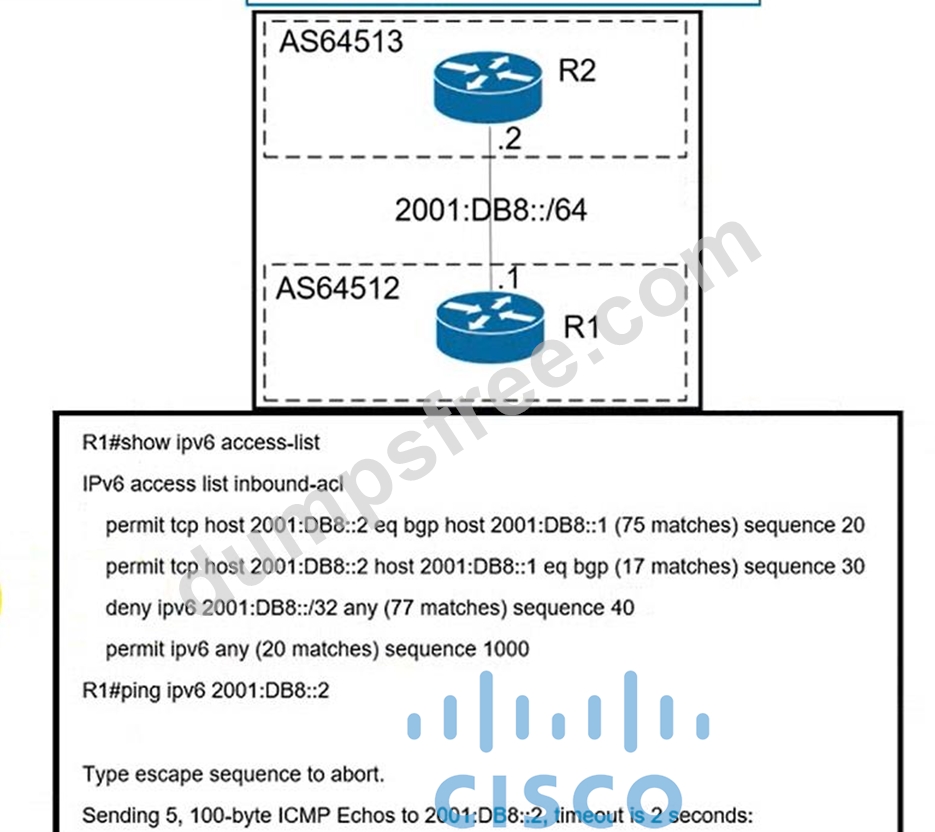
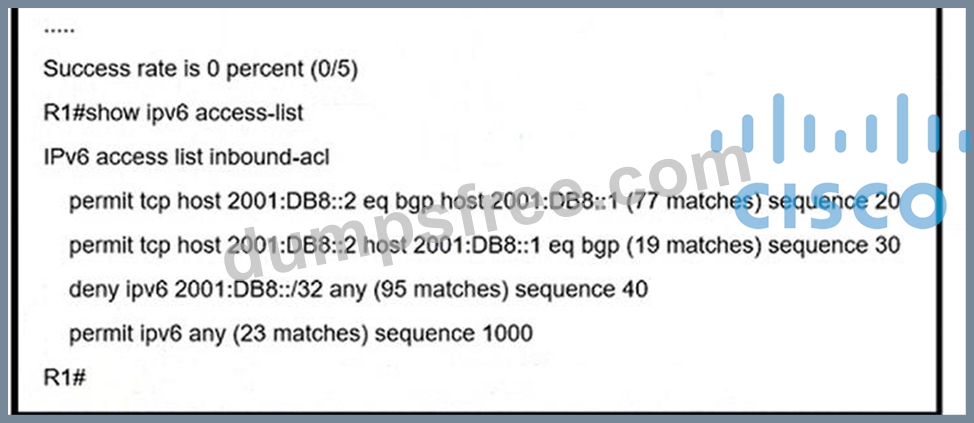
Refer to the exhibit. An engineer applied filter on R1 The interface flapped between R1 and R2 and cleaning the BGP session did not restore the BGP session and failed Which action must the engineer take to restore the BGP session from R2 to R1?
- A. ICMPv6 must be permitted by the IPv6 traffic filter
- B. Apply the IPv6 traffic filter in the outbound direction on the interface
- C. Enable the BGP session, which went down when the session was cleared.
- D. Swap the source and destination IP addresses in the IPv6 traffic filter
Answer: A
NEW QUESTION # 213
Refer to the exhibit.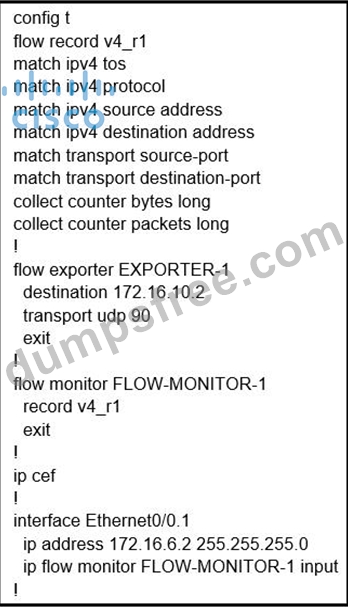
Why is the remote NetFlow server failing to receive the NetFlow data?
- A. The flow exporter is configured but is not used.
- B. The destination of the flow exporter is not reachable.
- C. The flow monitor is applied to the wrong interface.
- D. The flow monitor is applied in the wrong direction.
Answer: B
NEW QUESTION # 214
Refer to the exhibit.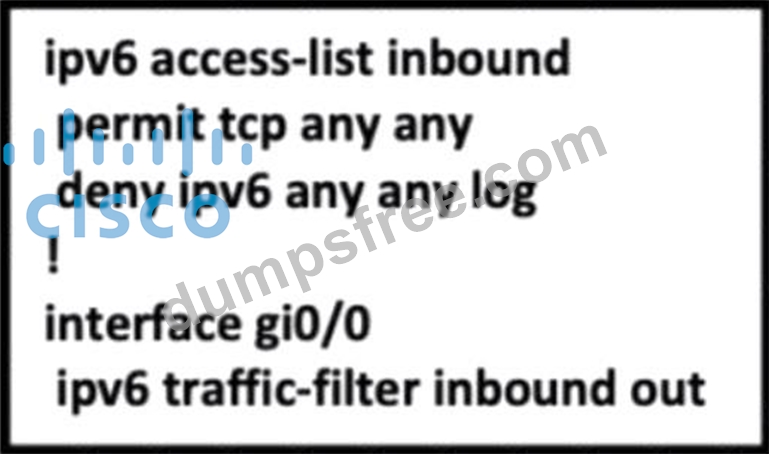
A network administrator configured an IPv6 access list to allow TCP return frame only, but it is not working as expected. Which changes resolve this issue?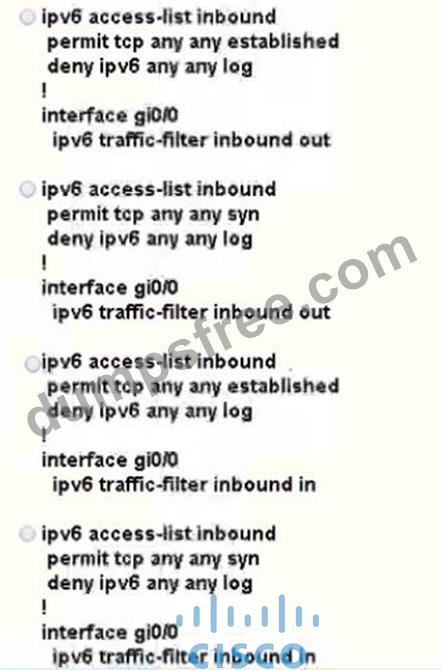
- A. Option D
- B. Option B
- C. Option C
- D. Option A
Answer: C
Explanation:
Explanation
https://www.cisco.com/c/en/us/td/docs/switches/lan/catalyst3750/software/release/122_55_se/configuration/guid
NEW QUESTION # 215
Which list defines the contents of an MPLS label?
- A. 20-bit label; 3-bit flow label; 1-bit bottom stack; 8-bit hop limit
- B. 20-bit label; 3-bit traffic class; 1-bit bottom stack; 8-bit TTL
- C. 32-bit label; 3-bit flow label; 1-bit bottom stack; 8-bit hop limit
- D. 32-bit label; 3-bit traffic class; 1-bit bottom stack; 8-bit TTL
Answer: B
Explanation:
Section: VPN Technologies
Explanation/Reference: https://tools.ietf.org/html/rfc5462
NEW QUESTION # 216
Refer to the exhibit.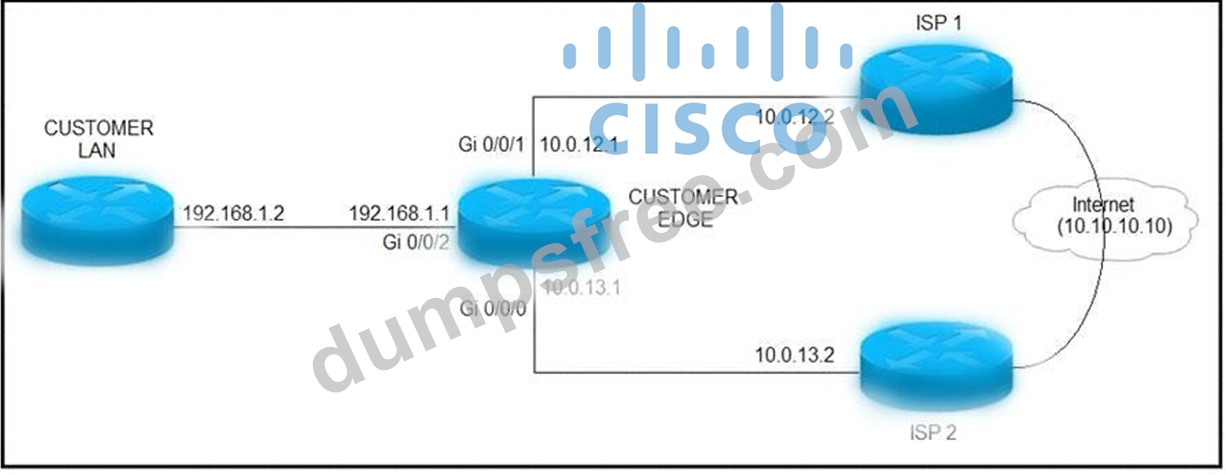
ISP 1 and ISP 2 directly connect to the Internet. A customer is tracking both ISP links to achieve redundancy and cannot see the Cisco IOS IP SLA tracking output on the router console. Which command is missing from the IP SLA configuration?
- A. Start-time now
- B. Start-time immediately
- C. Start-time 0
- D. Start-time 00:00
Answer: A
NEW QUESTION # 217
Drag and drop the OSPF adjacency states from the left onto the correct descriptions on the right.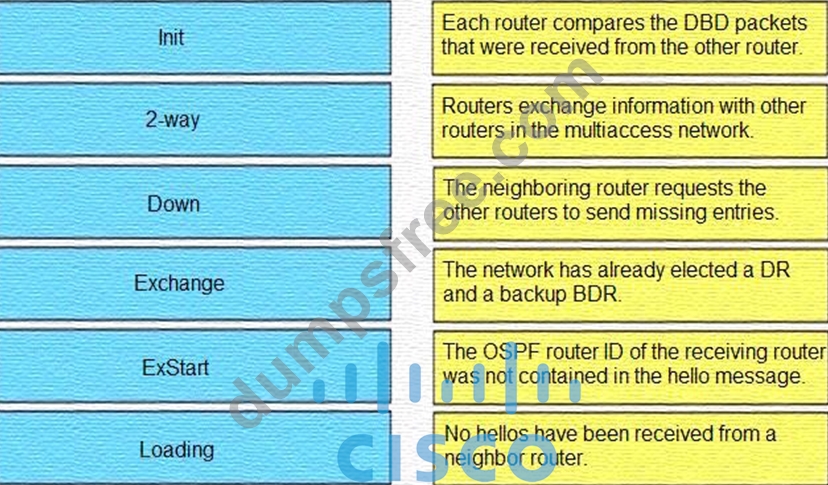
Answer:
Explanation: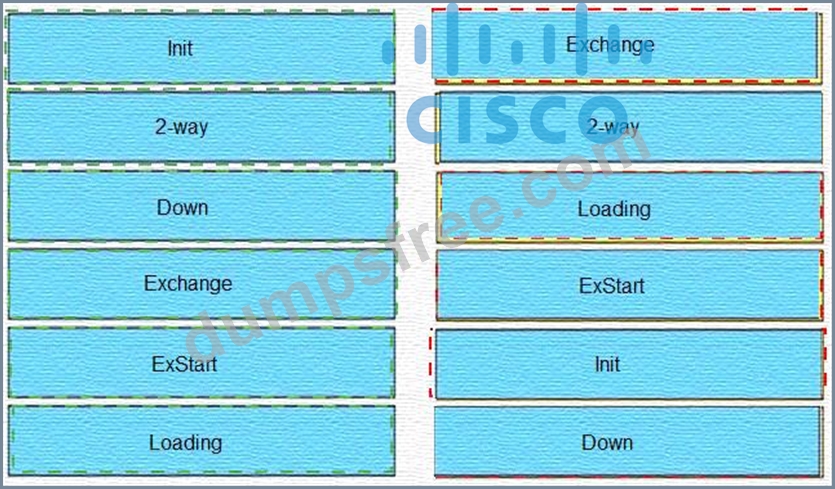
Explanation
Table Description automatically generated
(Reference: http://www.cisco.com/en/US/tech/tk365/technologies_tech_note09186a0080093f0e.shtml) Reference: https://www.cisco.com/c/en/us/support/docs/ip/open-shortest-path-first-ospf/13685-13.html Down This is the first OSPF neighbor state. It means that no information (hellos) has been received from this neighbor, but hello packets can still be sent to the neighbor in this state.
During the fully adjacent neighbor state, if a router doesn't receive hello packet from a neighbor within the Router Dead Interval time (RouterDeadInterval = 4*HelloInterval by default) or if the manually configured neighbor is being removed from the configuration, then the neighbor state changes from Full to Down.
Attempt
This state is only valid for manually configured neighbors in an NBMA environment. In Attempt state, the router sends unicast hello packets every poll interval to the neighbor, from which hellos have not been received within the dead interval.
Init
This state specifies that the router has received a hello packet from its neighbor, but the receiving router's ID was not included in the hello packet. When a router receives a hello packet from a neighbor, it should list the sender's router ID in its hello packet as an acknowledgment that it received a valid hello packet.
2-Way
This state designates that bi-directional communication has been established between two routers.
Bi-directional means that each router has seen the other's hello packet. This state is attained when the router receiving the hello packet sees its own Router ID within the received hello packet's neighbor field. At this state, a router decides whether to become adjacent with this neighbor. On broadcast media and non-broadcast multiaccess networks, a router becomes full only with the designated router (DR) and the backup designated router (BDR); it stays in the 2-way state with all other neighbors. On Point-to-point and Point-to-multipoint networks, a router becomes full with all connected routers.
At the end of this stage, the DR and BDR for broadcast and non-broadcast multiaccess networks are elected.
For more information on the DR election process, refer to DR Election.
Note: Receiving a Database Descriptor (DBD) packet from a neighbor in the init state will also a cause a transition to 2-way state.
Exstart
Once the DR and BDR are elected, the actual process of exchanging link state information can start between the routers and their DR and BDR. (ie. Shared or NBMA networks).
In this state, the routers and their DR and BDR establish a master-slave relationship and choose the initial sequence number for adjacency formation. The router with the higher router ID becomes the master and starts the exchange, and as such, is the only router that can increment the sequence number. Note that one would logically conclude that the DR/BDR with the highest router ID will become the master during this process of master-slave relation. Remember that the DR/BDR election might be purely by virtue of a higher priority configured on the router instead of highest router ID. Thus, it is possible that a DR plays the role of slave. And also note that master/slave election is on a per-neighbor basis.
Exchange
In the exchange state, OSPF routers exchange database descriptor (DBD) packets. Database descriptors contain link-state advertisement (LSA) headers only and describe the contents of the entire link-state database.
Each DBD packet has a sequence number which can be incremented only by master which is explicitly acknowledged by slave. Routers also send link-state request packets and link-state update packets (which contain the entire LSA) in this state. The contents of the DBD received are compared to the information contained in the routers link-state database to check if new or more current link-state information is available with the neighbor.
Loading
In this state, the actual exchange of link state information occurs. Based on the information provided by the DBDs, routers send link-state request packets. The neighbor then provides the requested link-state information in link-state update packets. During the adjacency, if a router receives an outdated or missing LSA, it requests that LSA by sending a link-state request packet. All link-state update packets are acknowledged.
Full
In this state, routers are fully adjacent with each other. All the router and network LSAs are exchanged and the routers' databases are fully synchronized.
Full is the normal state for an OSPF router. If a router is stuck in another state, it is an indication that there are problems in forming adjacencies. The only exception to this is the 2-way state, which is normal in a broadcast network. Routers achieve the FULL state with their DR and BDR in NBMA/broadcast media and FULL state with every neighbor in the remaining media such as point-to-point and point-to-multipoint.
Note: The DR and BDR that achieve FULL state with every router on the segment will display FULL/DROTHER when you enter the show ip ospf neighbor command on either a DR or BDR. This simply means that the neighbor is not a DR or BDR, but since the router on which the command was entered is either a DR or BDR, this shows the neighbor as FULL/DROTHER.
Reference: https://www.cisco.com/c/en/us/support/docs/ip/open-shortest-path-first-ospf/13685-13.html Reference: http://www.cisco.com/en/US/tech/tk365/technologies_tech_note09186a0080093f0e.shtml) Reference: https://www.cisco.com/c/en/us/support/docs/ip/open-shortest-path-first-ospf/13685-13.html
NEW QUESTION # 218
Which SNMP verification command shows the encryption and authentication protocols that are used in SNMPV3?
- A. show snmp
- B. show snmp view
- C. show snmp group
- D. show snmp user
Answer: D
NEW QUESTION # 219
Refer to the exhibit.
When monitoring an IPv6 access list, an engineer notices that the ACL does not have any hits and is causing unnecessary traffic to pass through the interface Which command must be configured to resolve the issue?
- A. ip access-group INTERNET in
- B. ipv6 access-class INTERNET in
- C. access-class INTERNET in
- D. ipv6 traffic-filter INTERNET in
Answer: B
NEW QUESTION # 220
Refer to Exhibit.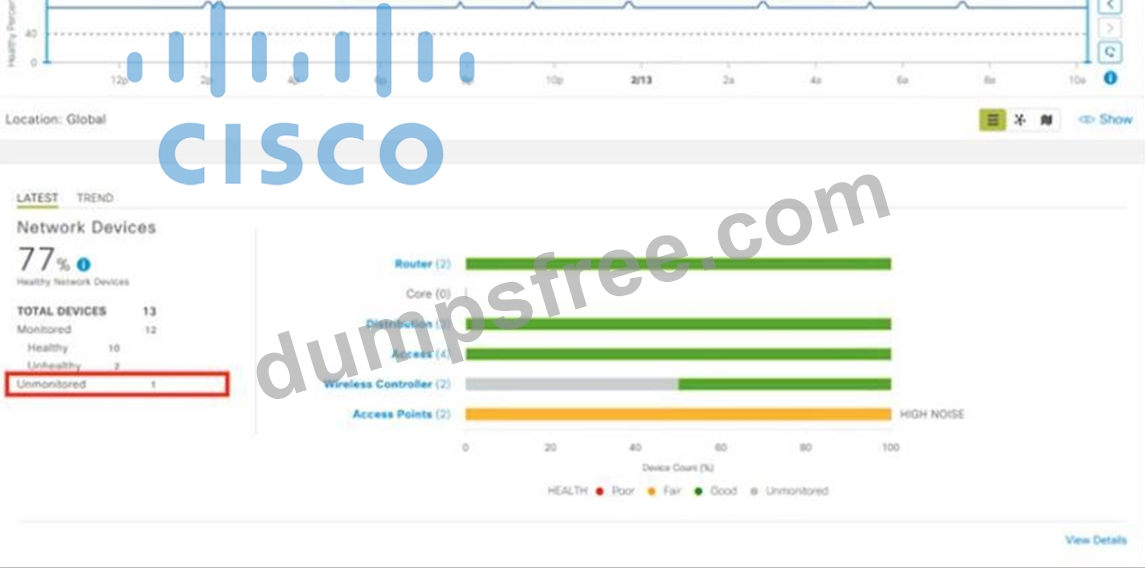
A network administrator added one router in the Cisco DNA Center and checked its discovery and health from the Network Health Dashboard. The network administrator observed that the router is still showing up as unmonitored. What must be configured on the router to mount it in the Cisco DNA Center?
- A. Configure router with NetFlow data
- B. Configure router with routing to reach Cisco DNA Center
- C. Configure router with the telemetry data
- D. Configure router with SNMPv2c or SNMPv3 traps
Answer: C
Explanation:
Explanation
Unmonitored: Unmonitored devices are devices for which Assurance did not receive any telemetry data during the specified time range.
NEW QUESTION # 221
Refer to the exhibit.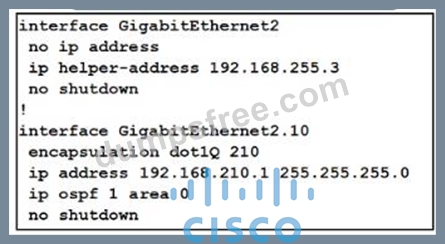
With the partial configuration of a router-on-a-stick. Clients in VLAN 10 on Gi2 cannot obtain IP configuration from the central DHP server is reachable by a successful ping from the route. Which action resolves the issue?
- A. Configure a valid IP address on the Gi2 interface so that DHCP requests can be forwarded.
- B. Configure the Ip dhcp excluded-address 192.168.255.3 command on the Gi1.10 subinterface.
- C. Configure the ip header-address 192-168.265.3 command on the Gi2 10 subinterface.
- D. Configure the ip/ip/dhcp pool f and network 192.168..210.0.255.255/0 commands.
Answer: C
NEW QUESTION # 222 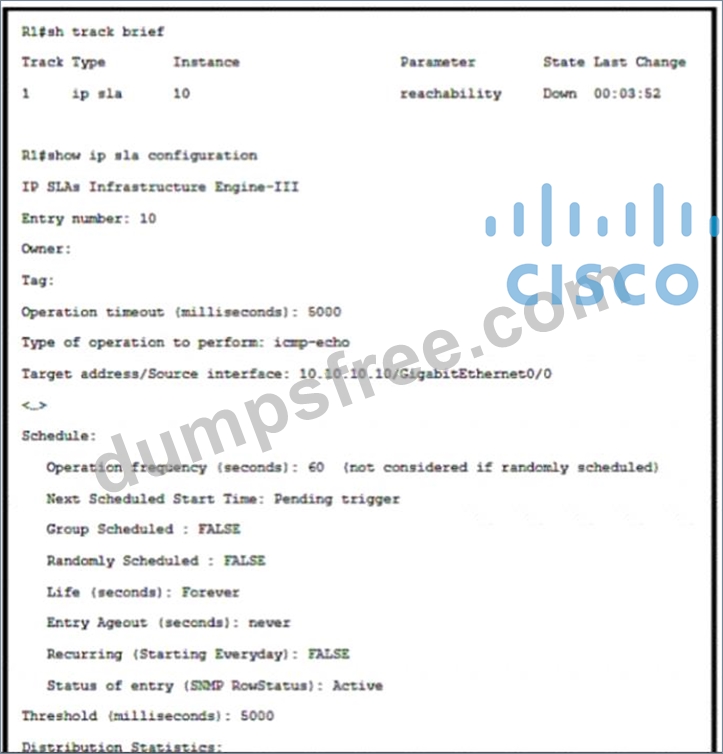
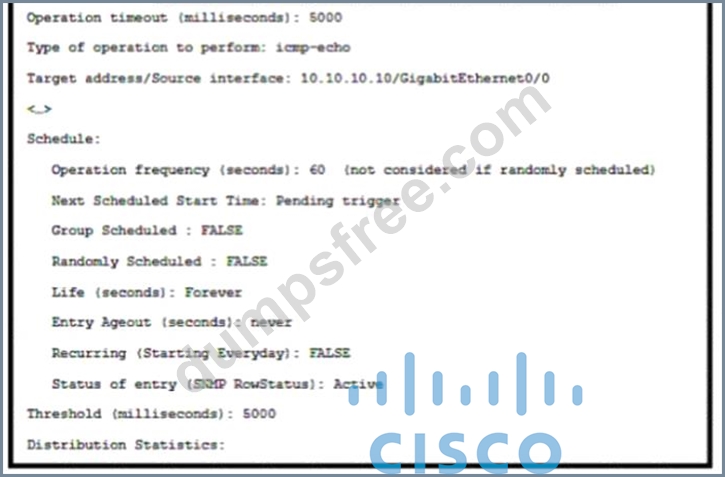
Refer to the exhibit A network engineer notices that the configured track option is down Which configuration resolves the issue*?
- A. ip sla schedule 10 no timeout
- B. ip sla schedule 10 no threshold
- C. ip sla schedule 10 start-time pending life forever
- D. ip sla schedule 10 start-time now
Answer: D
NEW QUESTION # 223 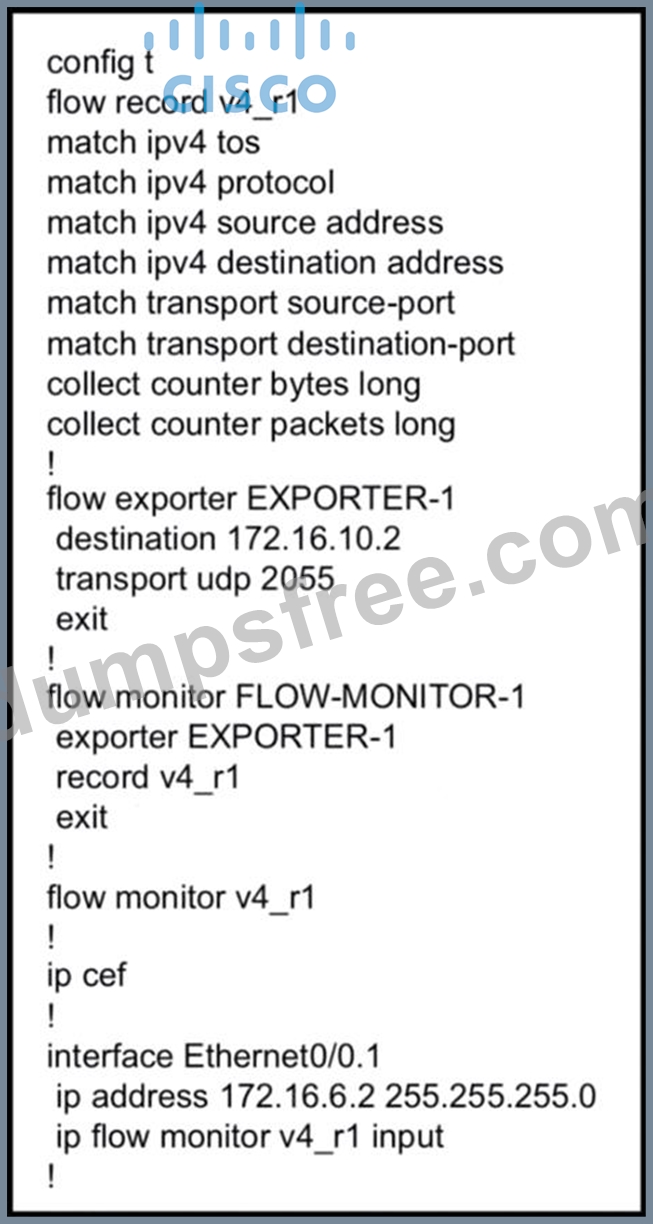
Refer to the exhibit. The remote server is failing to receive the NetFlow data Which action resolves the issue?
- A. Modify the flow record command record v4_r1 to move under flow exporter profile.
- B. Modify the interlace command to Ip flow monitor FLOW-MONITOR-1 Input.
- C. Modify the udp port under flow exporter profile to Ip transport udp 4739.
- D. Modify the flow transport command transport udp 2055 to move under flow monitor profile.
Answer: B
Explanation:
From the exhibit we see there are two flow monitors: the first one "FLOW-MONITOR-1" has been configured correctly but the second one "v4_r1" was left empty andinterface E0/0.1 is using it. So the remote server does not receive any NetFlow data.
NEW QUESTION # 224
An engineer configured SNMP notifications sent to the management server using authentication and encrypting data with DES. An error in the response PDU is received as "UNKNOWNUSERNAME.
WRONGDIGEST". Which action resolves the issue?
- A. Configure the correct authentication password using SNMPv3 authPriv .
- B. Configure the correct authentication password using SNMPv3 authNoPriv.
- C. Configure correct authentication and privacy passwords using SNMPv3 authNoPriv.
- D. Configure correct authentication and privacy passwords using SNMPv3 authPriv.
Answer: D
Explanation:
Explanation
https://www.cisco.com/c/en/us/td/docs/ios-xml/ios/snmp/configuration/xe-3se/3850/snmp-xe-3se-3850-book/nm
NEW QUESTION # 225
Drag and drop the MPLS terms from the left onto the correct definitions on the right.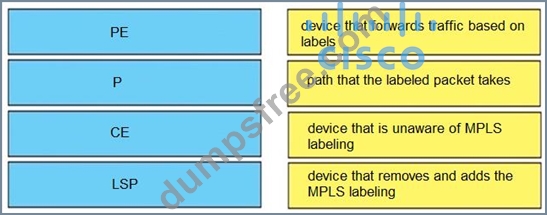
Answer:
Explanation: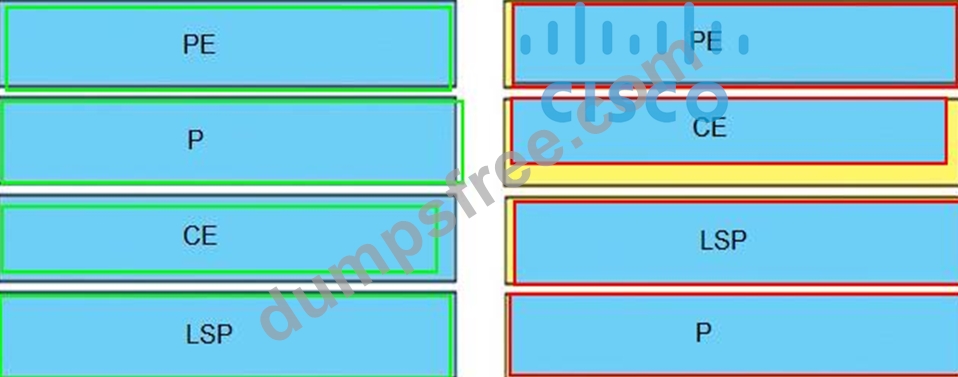
NEW QUESTION # 226
Refer to the exhibit.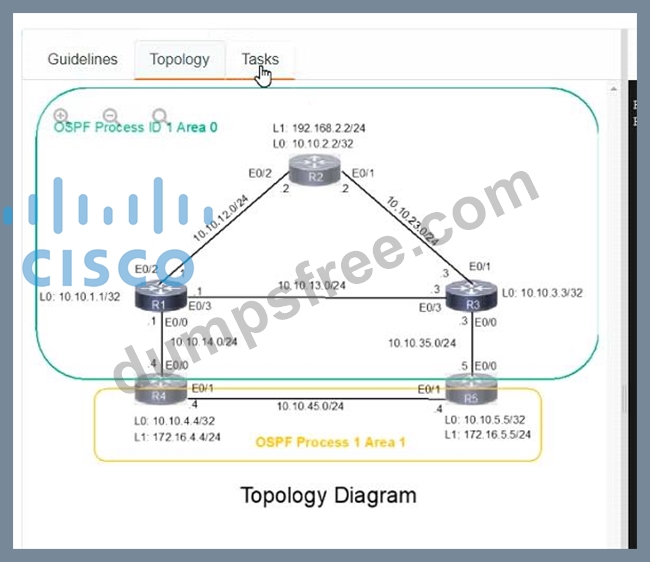
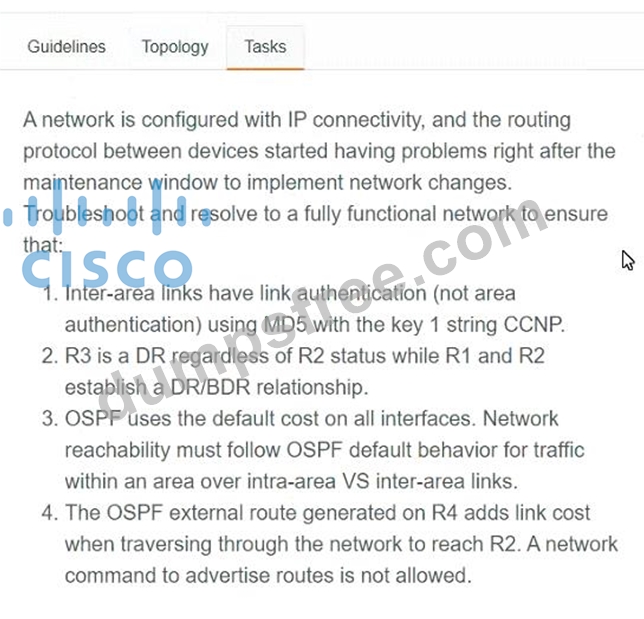
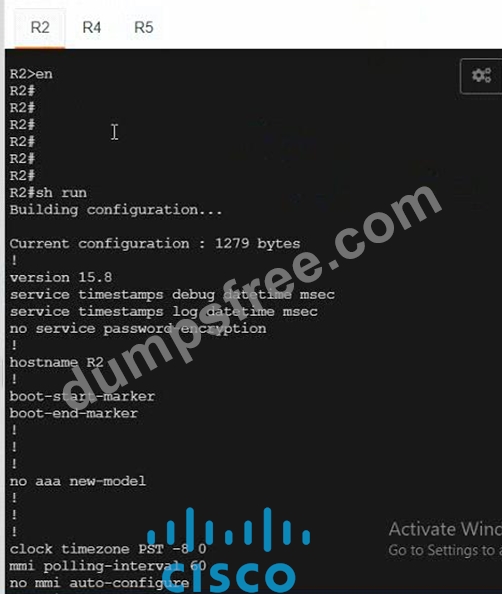
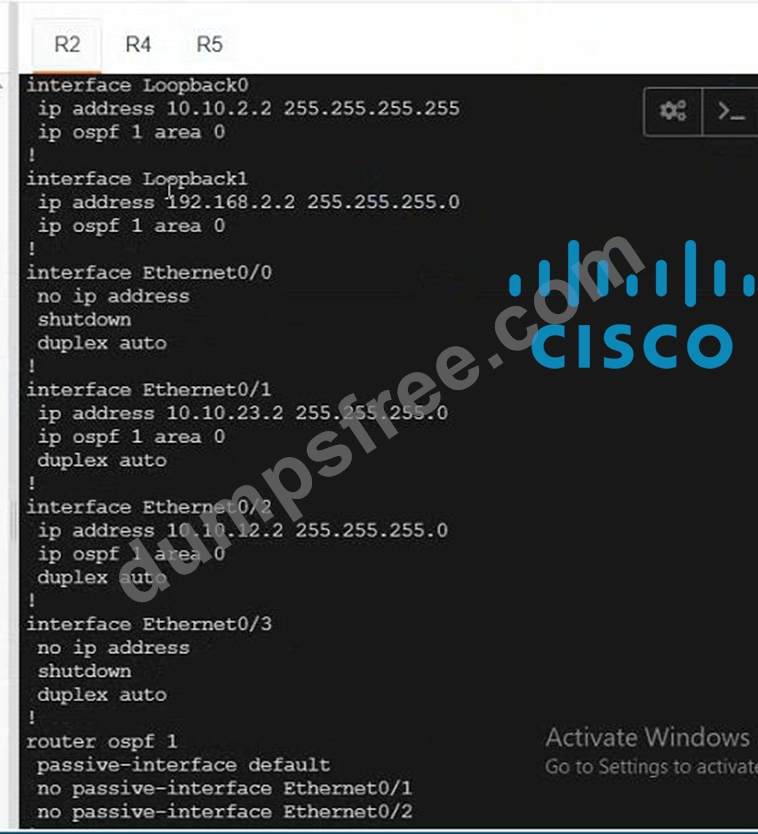
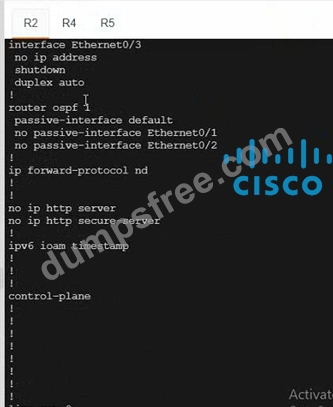
R4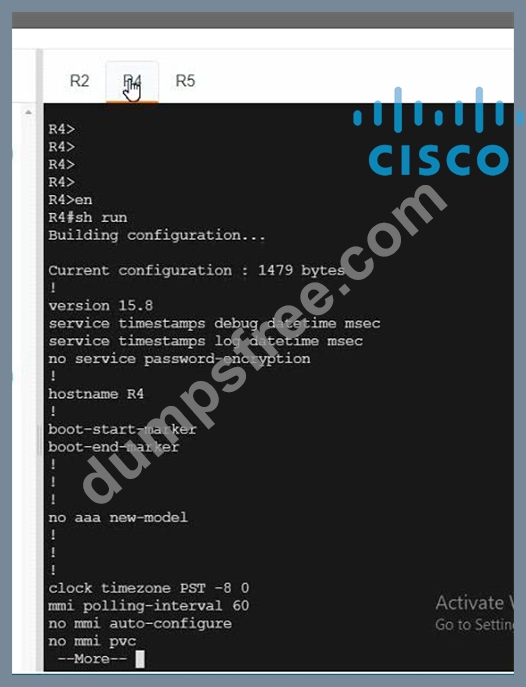
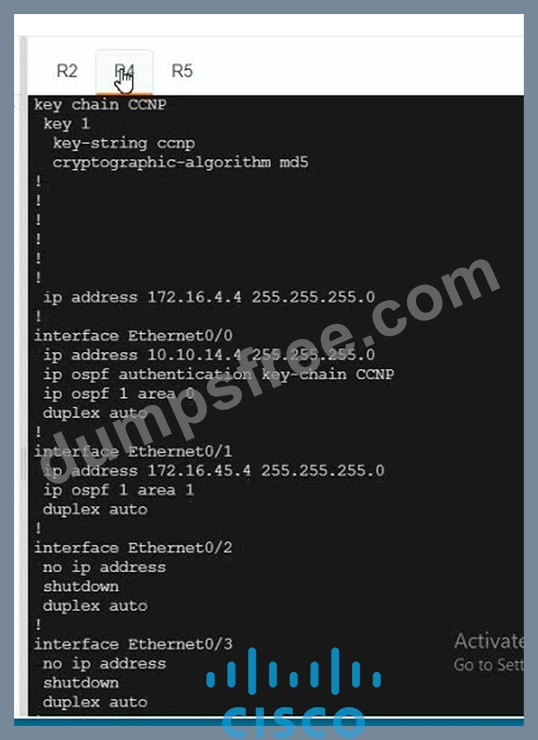
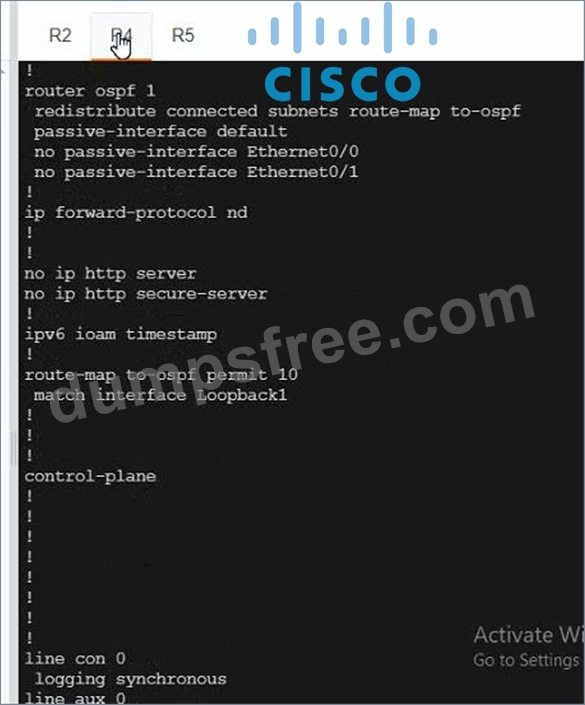
R5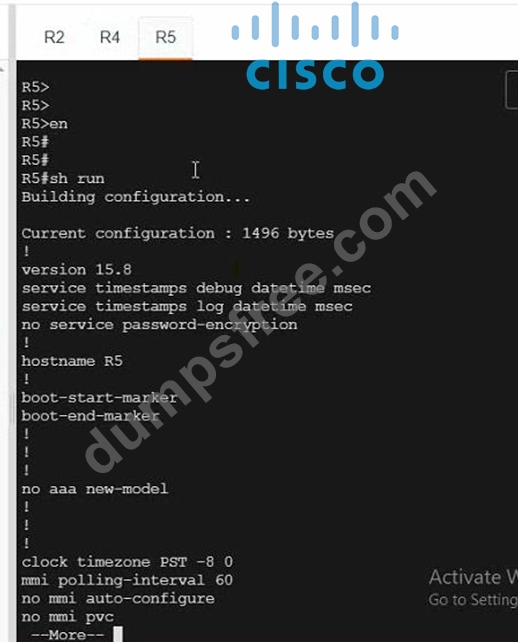
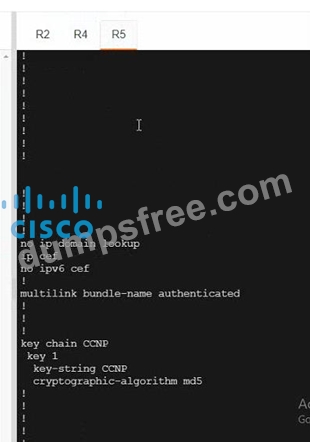
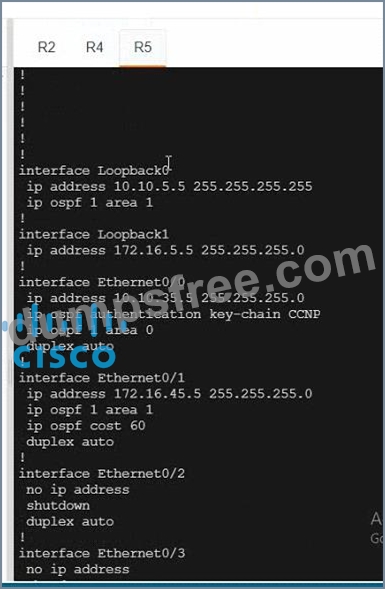
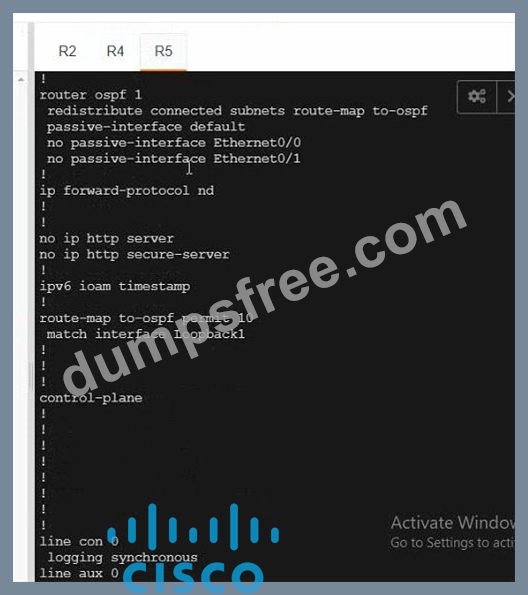
Answer:
Explanation:
R4
Int range et0/0 - 1
Ip ospf authentication message-digest
Ip ospf message-digest-key 1 md5 CCNP
Router ospf 1
Redistribute connected subnets route-map to-ospf metric-type 1
Copy run start
R5
Int range et0/0 - 1
Ip ospf authentication message-digest
Ip ospf message-digest-key 1 md5 CCNP
Interface eth 0/1
Ip ospf cost 10
Copy run start
VERIFICATION:-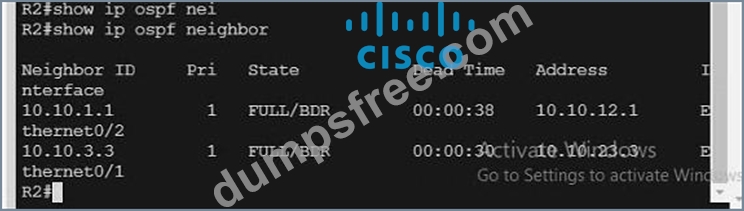
NEW QUESTION # 227 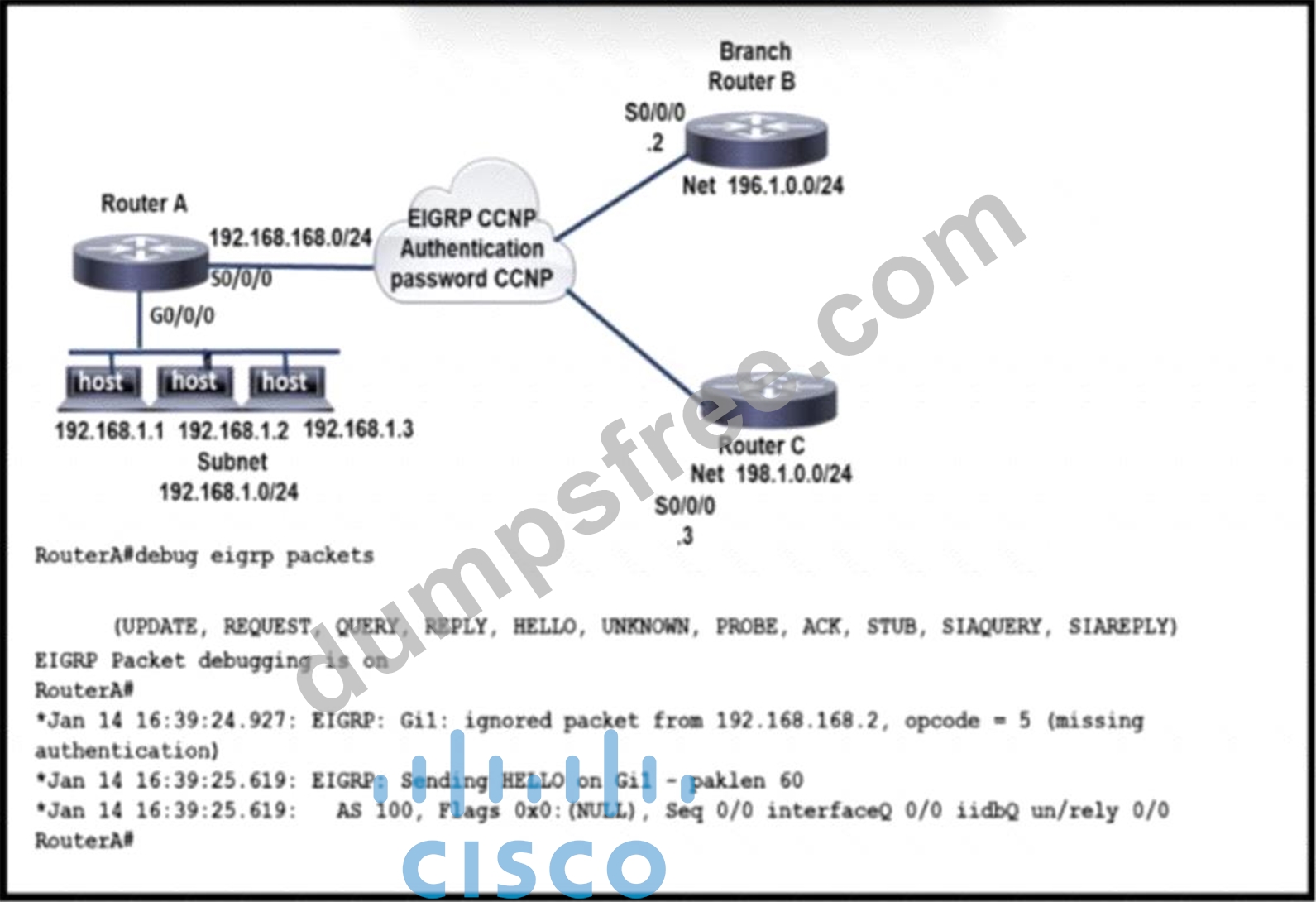
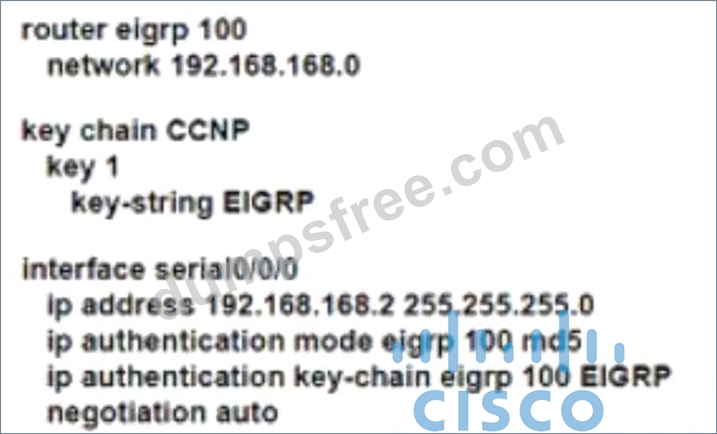
Refer to the exhibit. The services at branch B are down. An engineer notices mal rouler A and router B are not exchanging any routes Which configuration resolves the issue on router B?
- A.
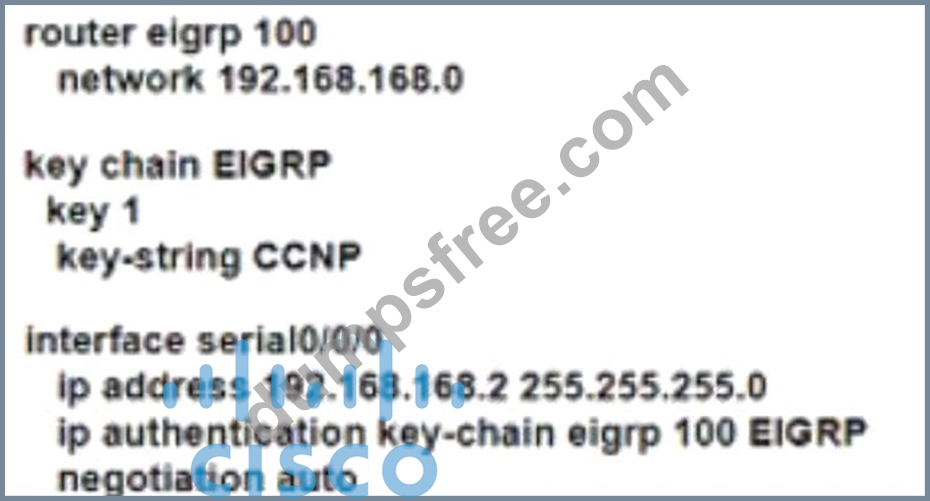
- B.
- C.
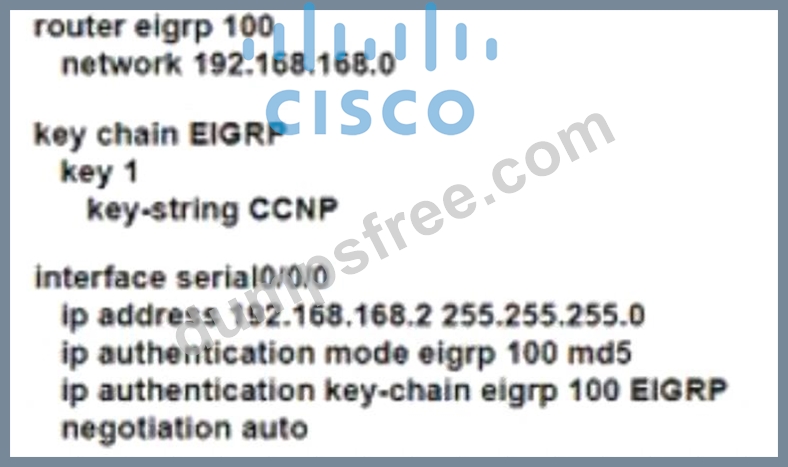
- D.
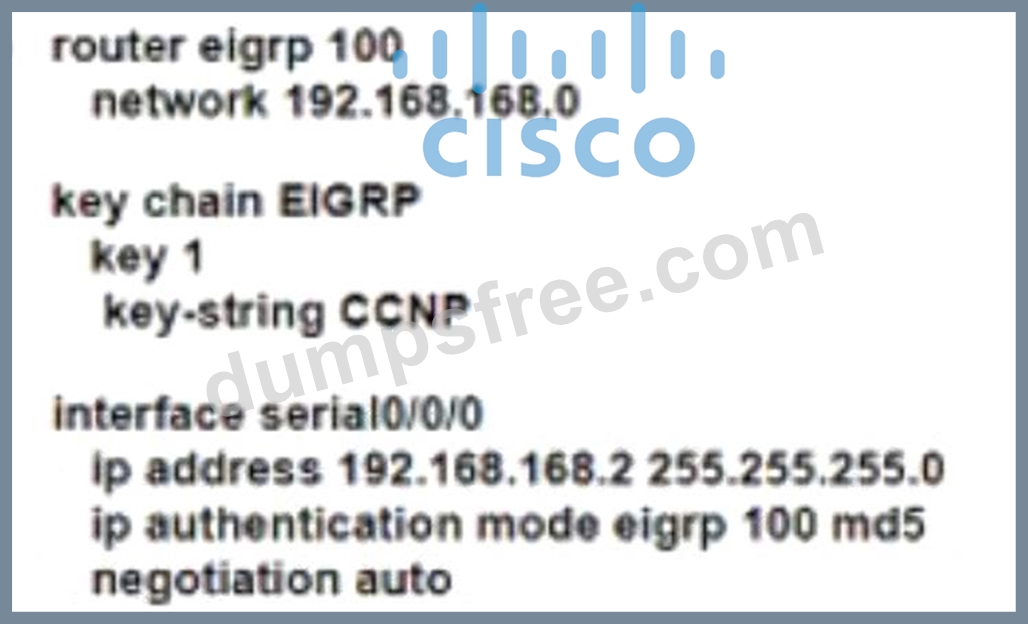
Answer: C
NEW QUESTION # 228
When determining if a system is capable of support, what is the minimum time spacing required for a BFD control packet to receive once a control packet is arrived?
- A. Detect Mult
- B. Required Min RX Interval
- C. Desired Min TX Interval
- D. Required Min Echo RX Interval
Answer: B
Explanation:
Required Min RX Interval: This is the minimum interval, in microseconds, between received BFD Control packets that this system is capable of supporting.
NEW QUESTION # 229
Exhibit: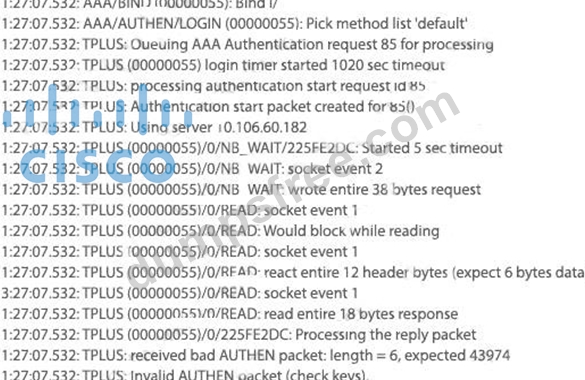
Which action resolves the authentication problem?
- A. Configure the same password between the TACACS+ server and router.
- B. Configure the TCP port 49 to be reachable by the router
- C. Configure the UDP port 1812 to be allowed on the TACACS+ server
- D. Configure the user name on the TACACS+ server
Answer: A
Explanation:
Explanation
From the last line of the output, we notice that the result was "Invalid AUTHEN packet". Therefore something went wrong with the username or password.
NEW QUESTION # 230
......
300-410 Braindumps – 300-410 Questions to Get Better Grades: https://prep4sure.dumpsfree.com/300-410-valid-exam.html