


Updated Mar-2026 Exam Materials for You to Prepare & Pass AACE-PSP Exam.
Pass Your AACE-PSP Exam at the First Try with 100% Real Exam
Possessing an AACE-PSP certification has numerous benefits for professionals in the field of project planning and scheduling. It provides them with a competitive edge, enhanced job opportunities, and recognition and credibility for their skills and expertise. It also opens up doors for networking and personal development opportunities by offering them access to AACE’s global network of professionals and educational resources. Ultimately, the AACE-PSP certification enhances the careers of certified professionals by providing them with the skills and expertise required to successfully plan and execute projects on time, within budget, and to the satisfaction of clients.
NEW QUESTION # 89
What method would be the best way to determine the most likely as-built critical path of a project that is underway, and the schedule of which has been partially progressed?
- A. Use the progressed portion of the critical path of the baseline schedule.
- B. Use the progressed portion of the critical path of all the updates previous to the current update.
- C. Interview the project personnel for their perceptions and opinions because the schedule is usually inadequate.
- D. Use the forward-looking critical path of the most current updates.
Answer: D
Explanation:
Understanding As-Built Critical Path Analysis:
Determining the as-built critical path of a project involves identifying the sequence of activities that actually dictated the completion of the project. This is especially important in projects that are underway, as schedules often deviate from the original baseline due to progress updates and unplanned changes.
Explanation of Each Option:
A). Use the progressed portion of the critical path of all the updates previous to the current update:
This is correct. To determine the most likely as-built critical path, analyzing the progressed portion of the critical path from all previous updates provides the most accurate representation of the project's actual execution. By reviewing the progression over time, you can piece together the actual sequence of critical activities.
B). Use the progressed portion of the critical path of the baseline schedule:
This is incorrect. The baseline schedule reflects the original plan, which may no longer be accurate due to progress deviations, delays, or changes in logic. Using the baseline alone does not account for the dynamic nature of the project.
C). Interview the project personnel for their perceptions and opinions because the schedule is usually inadequate:
This is incorrect. While project personnel may provide insights, relying solely on subjective opinions introduces biases and inconsistencies. A properly maintained and updated schedule is far more reliable for determining the critical path.
D). Use the forward-looking critical path of the most current updates:
This is incorrect. The forward-looking critical path only reflects what is expected to happen from the current point onward. It does not provide an accurate representation of the as-built critical path up to the current point.
* Study Guide Reference:
The PSP Study Guide emphasizes the importance of analyzing progress updates to trace the actual sequence of critical activities. Section 2.3.2 (Tracking Schedule Progress) discusses the role of historical updates in understanding project performance.
The guide also highlights that a proper as-built analysis requires a review of all updates to identify shifts in the critical path over time.
NEW QUESTION # 90
Each of the following accurately describes total float in a schedule EXCEPT:
- A. The amount of time an activity can be delayed without delaying the start or occurrence of any other activity or event in the network.
- B. The amount of time an activity can be delayed without delaying the overall project completion time.
- C. Can be positive or negative.
- D. Computed for an activity by subtracting its early finish from its late finish, or its early start from its late start.
Answer: A
NEW QUESTION # 91
When resource leveling craft labor for a critical path schedule, the scheduler
- A. Can depend on the results of the resource leveling operation to reflect a useful realignment of all schedule activities without 'further analysis.
- B. Need not consider its effects, as it is a theoretical concept with limited application to construction projects.
- C. Must consider breaks in continuity of work for subcontractors, thereby possibly incurring additional subcontractor mobilization and demobilization costs.
- D. Need only consider the non-union crafts persons.
Answer: C
Explanation:
* Resource Leveling:
Resource leveling adjusts start and finish dates of activities to resolve resource conflicts or constraints, balancing availability and demand.
In construction projects, breaks in continuity of work for subcontractors can result in increased costs due to remobilization and demobilization.
* PSP Study Guide Reference:
The PSP guide explains that resource leveling must be carefully analyzed to avoid disruptions in work continuity.
* Conclusion: The correct answer is A, as the scheduler must account for potential cost implications of resource leveling on subcontractors.
NEW QUESTION # 92
Which of the following is the most important scheduling consideration for the BILCO contractual scope?
- A. Logical phasing lies
- B. Cost loading
- C. Conforming CPM schedule to SDOT standards
- D. Update frequency
Answer: A
NEW QUESTION # 93
At the end of month one, did the delay to the parking structure foundation delay the project?
- A. Yes, by 4 calendar days.
- B. NO.
- C. Yes, by 14 calendar days.
- D. Yes, by 9 calendar days.
Answer: D
Explanation:
* Scenario Review:
Delay in the parking structure foundation is an off-critical path activity.
No impact on the overall project completion date.
* Delay Analysis:
While the foundation activity is delayed, the float ensures that no downstream activities are impacted.
* Cross-Verification:
Option B: Incorrect. Assumes a 4-day impact.
Option C: Incorrect. Overestimates delays.
Option D: Incorrect. Miscalculates delays.
NEW QUESTION # 94
What is a critical path method schedule?
- A. The timeline of the riskiest work
- B. A graphical means of showing the important work
- C. A network diagram of logically interconnected activities
- D. List of work to be accomplished by responsible party and when it is to be accomplished
Answer: C
Explanation:
* Definition of a Critical Path Method (CPM) Schedule:
CPM schedules are based on network diagrams that logically link activities, showing the sequence and dependencies between them.
These schedules identify the critical path, which is the longest path through the network, determining the project's shortest possible duration.
* Evaluation of Options:
Option A: Incorrect. While CPM schedules do include tasks and timelines, the defining feature is the logical interconnection of activities.
Option B: Incorrect. CPM schedules are not limited to "risky" work; they show all activities.
Option C: Incorrect. CPM schedules use network diagrams, not just graphical representations.
Option D: Correct. The network diagram is the key characteristic of CPM schedules.
NEW QUESTION # 95
SIMULATION
Background
Your name is Evan Marshal. You are the corporate scheduler for Happy Insurance Corporation (HIC), a general health insurance company located in Ridgemond, Illinois. HIC is very busy with 49 unique software development projects. The organization structure at HIC gives the project scheduling responsibility to the Project Manager assigned to each project. You are charged with coordination of the project schedules into a Master Schedule and quality control for scheduling on the individual development projects. You report directly to the Director of Information Services (DIS), Desmond Rayburn.
It has come to your attention Project JP-114 has fallen behind schedule and Rita Belateau, the Project Manager, wants to accelerate the project in order to reclaim lost time. Rita is a strong supporter of Total Quality Management and strives for zero failures; therefore she is assessing the need for overtime for resources assigned to an activity that is not projecting a completion prior to the early finish depicted in the current schedule.
You and Rita review the current schedule to identify which activities are on the critical path and which activities have plenty of float. The review reveals several activities have suffered less than planned productivity and have contributed to falling behind. In the process of this review, you and Rita also review the budget for Project JP-114 and notice not only the schedule has fallen behind but the cost to date is more than she had expected. To total budget is $150,000, planned to date is $30,000; expended to date is $37,000.
With nine months remaining until baseline contract completion, Rita needs to bring Project JP-114 back on track; knowing overtime for an extended period of time is not always the right answer, especially with the cost to date already over planned.
In order to truly understand the options available to help remedy the current situation, you and Rita brainstorm on several potential courses of action. All the potential courses of action will require an evaluation of budget impact versus schedule correction.
1. Pull the project team together and ensure everyone understands which activities are on the critical path. Rita would like to use the existing project team and focus them on these critical path activities, laying out a plan for periodic overtime when needed to crunch through a deliverable. This approach could add approximately 20% to the budget.
2. Outsource various modules of activities to qualified and known consultants. This could drive up the costs and must be evaluated before implemented. Having an outside source working in parallel with the project team could also accelerate the schedule to mitigate some of the delays, as well as keep overtime down to a minimum for the project team. Potentially this could add as much as 40% to the budget, but could also be very productive schedule wise.
3. Mandatory overtime for the project team - entire project goes on a 50-hour work week. If the entire project team works overtime for an extended period of time, the budget could see an additional 60% increase.
4. The project continues as is completes the project late and accepts the penalties imposed. Penalties imposed for late delivery could add as much as 50% to the budget.
Assignment
Draft a proper memorandum to Desmond Raybum, IS Director, explaining in your own words:
a). the current problem and potential impact(s);
b). each course of action, stating advantages and disadvantages as appropriate; c. your recommendations, properly supported.
Please be sure to include the rationale for your recommendations. Be sure to summarize your thoughts and address (To, From, Date, and Subject/Project Name) and close the memo appropriately. If you are uncomfortable with the courses of action noted, provide your own with appropriate substantiation for your position. Limit your answer to one, full typewritten page (roughly three handwritten pages).
While your email can be a detailed as you like, be sure to write sufficiently to address each element of the assignment, yet not so long that you go beyond the scope of the exercise.
Take time to read the problem and consider what you want Evan to say. Good luck!
Answer:
Explanation:
See the Explanation for complete Solution for this
Explanation:
To: Desmond Rayburn, Director of Information Services
From: Evan Marshal, Corporate Scheduler
Date: [Insert Current Date]
Subject: Mitigation Plan for Project JP-114 Delays
Current Problem and Potential Impacts
Project JP-114 has experienced schedule delays and cost overruns. The project has expended $37,000 against a planned budget of $30,000 to date, exceeding the planned budget by 23%. Additionally, productivity issues have impacted critical path activities, further delaying progress. With nine months remaining, failing to address these issues could result in penalties, further cost increases, and client dissatisfaction.
Courses of Action
Focus Existing Team on Critical Path with Periodic Overtime
Advantages: Uses team familiarity; incurs a moderate budget increase (20%).
Disadvantages: Risks resource strain and potential burnout if overtime is prolonged.
Outsource Work to Consultants
Advantages: Accelerates schedule by parallel work streams; minimizes internal team overtime.
Disadvantages: Higher budget impact (up to 40%); requires effective integration of external deliverables.
Mandatory Overtime (50-Hour Work Week)
Advantages: Ensures rapid progress across the project.
Disadvantages: Extremely high cost (60% increase); risks significant employee fatigue and declining morale.
Continue as Is and Accept Late Delivery Penalties
Advantages: No immediate resource strain.
Disadvantages: Significant penalties (50% budget increase); damages stakeholder confidence and corporate reputation.
Recommendation
I recommend Option 1, combined with selective outsourcing (Option 2), to achieve the best balance of cost control and schedule recovery.
Focus the internal team on critical path activities with targeted use of periodic overtime. This ensures efficient allocation of resources and minimizes strain while addressing the most urgent delays.
Outsource select non-critical tasks to experienced consultants. This parallel effort reduces the workload on the internal team, limits overtime, and accelerates overall progress.
Rationale:
This hybrid approach keeps the budget increase to approximately 30-35% while effectively addressing schedule delays. It balances cost efficiency, resource management, and stakeholder satisfaction. Proper coordination will ensure smooth integration between internal and external teams.
Conclusion
This plan provides the most feasible path to bringing Project JP-114 back on track. It mitigates risks of extended delays while maintaining budget discipline. I am available for further discussions to outline a detailed implementation plan.
Best Regards,
Evan Marshal
Corporate Scheduler
NEW QUESTION # 96
If a cost estimate assumes that 240 hours will be expended on a given activity, and the projected crew size expected to perform that activity is 5 personnel working and 8-hour workday, what is the calculated duration for the activity?
- A. 5 days
- B. 8 days
- C. 6 days
- D. 4 days
Answer: C
NEW QUESTION # 97
There is only enough room for a maximum of 4 cranes to be placed on-site. Assuming that a single crane can perform 35 lifts per day and that a column pour requires 60 lifts, what is the minimum number of tower cranes that should be used for the above described column pours?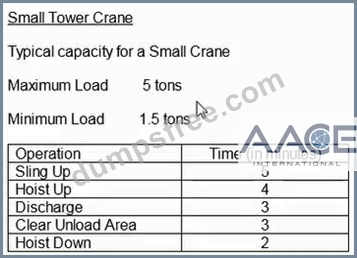
- A. 4 cranes
- B. 2 cranes
- C. 3 cranes
- D. 1 crane
Answer: B
NEW QUESTION # 98
In the "normal" schedule, excluding Activity 1000, what activity(s) are concurrent with Activity 3001?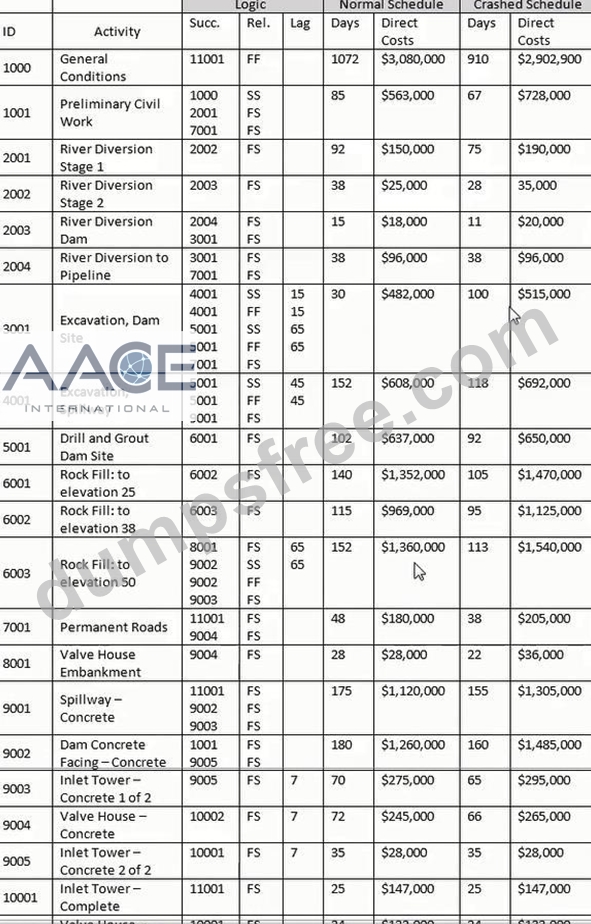
- A. 4001, 5001 and 6001.
- B. 2004.
- C. 4001 and 5001.
- D. 2003 and 7001.
Answer: C
NEW QUESTION # 99
If a detailed estimate is NOT available to assist in the formulation of activity durations but unit quantities have been identified, what information can be utilized to estimate work package/activity durations?
- A. Time impact analysis
- B. Historical production rates
- C. The Eichleay formula
- D. Black-Scholes model
Answer: B
NEW QUESTION # 100
What does the heavy, vertical line at "X" represent?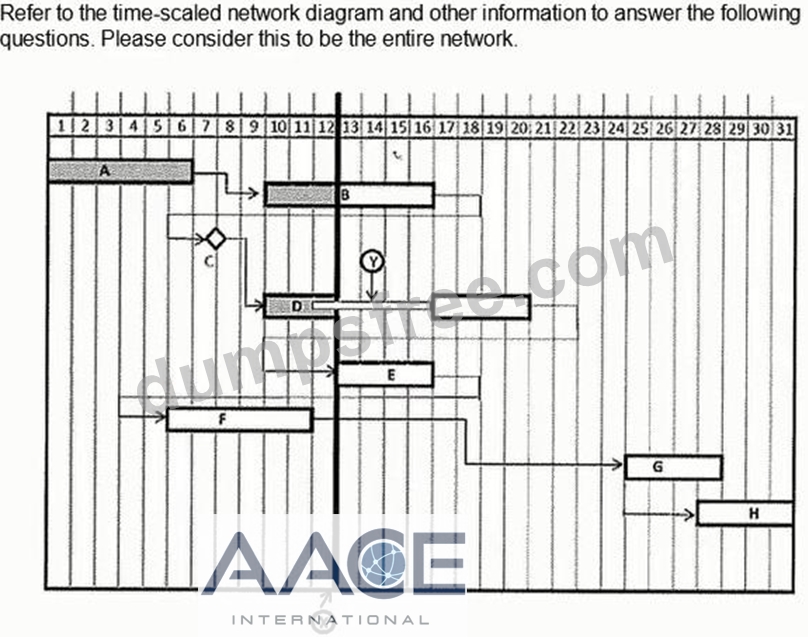
- A. International Date Line.
- B. Change-over limits.
- C. The status or data date.
- D. Delay fault line.
Answer: C
NEW QUESTION # 101
Time-scaled logic diagrams are
- A. Used to calculate the most probable activity duration.
- B. The same as a pure-logic diagram.
- C. Logic networks that are drawn to match the calendar.
- D. Only calculated using a computer.
Answer: C
Explanation:
* Time-Scaled Logic Diagrams:
Represent activities with respect to a time scale (e.g., a calendar).
Show logical relationships and durations in a visually aligned manner, aiding in analysis and reporting.
* Common Misconceptions:
They are not the same as pure logic diagrams (B).
While often created using computer software, manual versions are also possible, so (A) is incorrect.
They are not specifically for calculating activity durations (C).
* PSP Study Guide Reference:
The guide identifies time-scaled logic diagrams as a tool for better visualization of schedules, where activities align with calendar dates.
* Conclusion: The correct answer is D, as time-scaled logic diagrams are drawn to align activities with a calendar.
NEW QUESTION # 102
You are developing a detailed critical path schedule for a proposed petrochemical plant. The schedule will become a part of the project baseline document, which will be sent to the company's board of directors for its consideration. What document or resource is likely to be MOST valuable in determining the schedule's work activity durations?
- A. Critical path schedules prepared by you for similar completed projects.
- B. The cost estimate for the plant prepared by your firm's estimating department.
- C. Industry publications.
- D. The Petrochemical Industry New Plant Task Duration Handbook.
Answer: A
NEW QUESTION # 103
What project cost elements would NOT normally be reflected in the Activity 1000?
- A. Home office expenses
- B. CPM processing and updating
- C. Materials used in the construction
- D. Job site quality control
Answer: A
Explanation:
* Activity-specific costs in CPM schedules typically include direct expenses like materials (C), field-related overhead (D), and specific schedule management tasks (B).
* Home office expenses are classified as indirect costs and are not associated with any specific activity within the project schedule. They are accounted for in broader financial statements rather than in the activity-based budget.
* Reference: PSP Study Guide, Section 1.3.10 - Cost Estimate Development, explains how costs are categorized and assigned in schedules.
NEW QUESTION # 104
What is a key first step in developing a critical path method schedule?
- A. Setting out the resource to be used and its limitations.
- B. Drawing the logic diagram.
- C. Drawing a bar chart of the key phrases of the work.
- D. Defining the execution plan to meet the required scope of work.
Answer: B
NEW QUESTION # 105
SUBCO is a potential concrete bridge contractor based in a metropolitan area 300 miles away from your project. They have offered to supply manpower and equipment t BILCO at a per diem rate of $3,000 above their direct labor and equipment rates. In doing a cost benefit analysis, which of the following is NOT a consideration?
- A. SUBCO direct labor and equipment rates
- B. The distance of SUBCO to your project
- C. Pending negotiations with GOUGE.
- D. BILCO liquidated damages in the SDOT contract
Answer: C
Explanation:
A cost-benefit analysis for a subcontractor like SUBCO should focus on tangible and direct impacts to the project, including their labor and equipment rates, the potential for liquidated damages in the SDOT contract, and logistical concerns such as distance from the project site (PSP Study Guide, Section 1.2.4, "Project Variables"). Pending negotiations with a different entity, such as GOUGE, are unrelated to SUBCO's contract evaluation and are therefore not a consideration.
NEW QUESTION # 106
Midway through the project you received an executed change order for this project, adding thirty-three days to the contract for weather delays. In its simplest form, how would your next project update display the changed condition?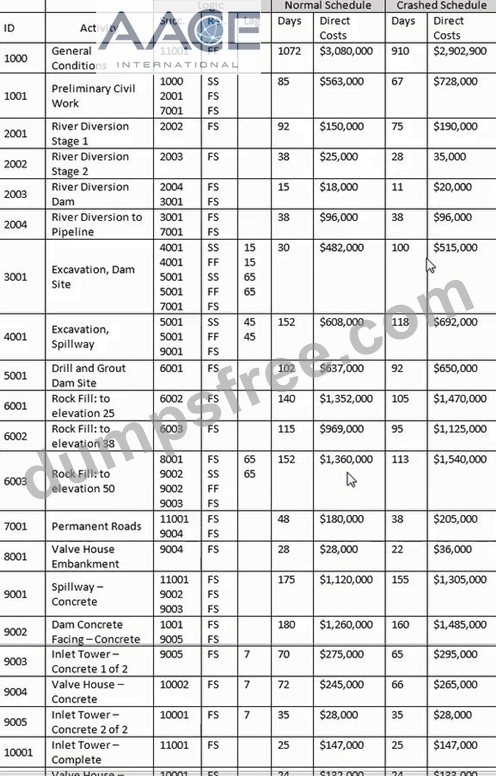
- A. After Activity 1000, add a new Activity 1050 with a start-to-start relationship to Activity 1000, and tie the end of this new activity with a finish-to-finish relationship to the final activity of the project.
- B. After Activity 1000, add a new Activity 1010 with a finish-to-start relationship to Activity 1000, and tie the end of this new activity with a finish-to-start relationship to the final activity of the project.
- C. After Activity 1001, add a new Activity 1011 with a finish-to-start relationship to Activity 1000, and tie the end of this new activity with a finish-to-start relationship to the final activity of the project.
Answer: A
Explanation:
* Scenario Overview:
A change order has been approved, adding 33 days for weather delays. This requires updating the schedule to reflect the extended contract duration.
* Impact on Scheduling:
The simplest and cleanest way to include the change is to create a new activity that represents the delay (e.g., Activity 1050).
The new activity is linked to Activity 1000 using a start-to-start (SS) relationship. This ensures the delay begins in parallel with the original contract start.
The finish-to-finish (FF) relationship with the final activity ensures that the extended duration impacts the project's overall timeline.
* Cross-Verification with PSP Principles:
PSP principles emphasize the importance of maintaining logical integrity and clarity when updating schedules for change orders (Ref: PSP Study Guide, Chapter 2B: Schedule Maintenance/Controlling). This method ensures traceability of the delay without affecting activity logic unnecessarily.
NEW QUESTION # 107
What activities are concurrent to Activity 2001 in the "normal" schedule?
- A. 2003.
- B. 1001.
- C. 1000.
- D. 7001.
Answer: B
Explanation:
Analyze Activity 2001 in the "Normal" Schedule:
Activity 2001 ("River Diversion Stage 1") has a duration of 92 days under the "Normal" schedule.
The logic column shows it has a Successor ID of 2002, and a Finish-to-Start (FS) relationship with no lag. This indicates that Activity 2002 will begin immediately after Activity 2001 finishes.
Identify Concurrent Activities Using the Schedule Logic:
To determine concurrency, we need to look for activities that overlap in time with Activity 2001 during its duration. Concurrent activities must either:
Start before Activity 2001 finishes, or
Finish after Activity 2001 starts.
Review Activities in the Normal Schedule:
Activity 1001 ("Preliminary Civil Work"):
Has a duration of 85 days, starts before Activity 2001, and overlaps with it.
Logic: Its successor is Activity 2001 (Start-to-Start [SS] relationship), confirming the overlap.
Activity 1000 ("General Conditions"):
Duration is 1072 days. However, this is an overarching activity, and its inclusion is not specific to being concurrent with Activity 2001.
Activity 7001 ("Permanent Roads"):
Starts much later, after Activity 2001 ends, and thus is not concurrent.
Activity 2003 ("River Diversion Dam"):
Starts after Activity 2001 completes (FS relationship), so it is not concurrent.
Conclusion:
The only activity that overlaps and runs concurrently with Activity 2001 in the "Normal" schedule is Activity 1001.
Reference:
PSP Study Guide (2019), Chapter on Schedule Development, Section 2.2.4 - Relationships: Discusses how Start-to-Start (SS) and other dependencies impact concurrency.
AACE Recommended Practice 10S-90: "Cost Engineering Terminology" for definitions of concurrent activities.
NEW QUESTION # 108
SUBCO is a potential concrete bridge contractor based in a metropolitan area 300 miles away from your project. They have offered to supply manpower and equipment t BILCO at a per diem rate of $3,000 above their direct labor and equipment rates. In doing a cost benefit analysis, which of the following is NOT a consideration?
- A. SUBCO direct labor and equipment rates
- B. The distance of SUBCO to your project
- C. Pending negotiations with GOUGE.
- D. BILCO liquidated damages in the SDOT contract
Answer: A
NEW QUESTION # 109
Select the most appropriate explanation for use of a winter/wet weather seasonal calendar for use in this project?
- A. to highlight a time when there are more holidays and work therefore will be slower and there will be more absenteeism
- B. to show a difference in the calendar year
- C. to provide a key to co-a weather for safety meetings
- D. to denote a time during which work may not progress as fast as planned and cost and risk may be elevated
Answer: D
Explanation:
The use of a winter/wet weather seasonal calendar is essential in planning and scheduling to account for climatic conditions that can impact project timelines. The PSP Study Guide emphasizes identifying project variables, such as environmental conditions, and incorporating them into the project plan to manage risks and constraints effectively. Seasonal calendars help planners predict periods of reduced productivity, increased costs, and potential delays due to adverse weather conditions (PSP Study Guide, Subchapter 1.2.4, "Project Variables").
These calendars are particularly useful for:
Forecasting potential schedule impacts during specific periods.
Enhancing the accuracy of risk management plans (PSP Study Guide, Section 1.3.13, "Risk and Recovery Plan").
Aiding in decision-making regarding resource allocation during slow periods.
NEW QUESTION # 110
When project risk is reflected in scheduled activities, what is the most significant characteristic of those activities?
- A. The Remaining Duration of the activity
- B. The level of resources available to the activity
- C. The Late Start of the last activity in that float path
- D. The criticality of toe activities
Answer: D
NEW QUESTION # 111
......
How much Planning & Scheduling Professional (PSP) Exam Cost
The cost of this exam differs according to the region from where you are applying from and the exact amount of the exam will be available when you complete the application at AACE's website and proceed to the payment section. Roughly speaking, it costs around USD 200. Hover on to the official website of AACE by clicking Apply now button from this website and choose your region for more pricing information. Other costs may also incur like buying the PSP exam dumps and then practicing for the exam via the PSP practice exams. If you have an AACE membership or you do apply for one, the certifications will be offered to you at discounted prices.
AACE International AACE-PSP (Planning & Scheduling Professional) Exam is a certification exam designed to test the competency of professionals in the field of project planning and scheduling. AACE International is a non-profit professional organization that has been setting the standard for project management and cost engineering for over 60 years. The AACE-PSP certification is a globally recognized credential that demonstrates the holder's expertise in advanced planning and scheduling techniques.
Updated AACE-PSP Certification Exam Sample Questions: https://prep4sure.dumpsfree.com/AACE-PSP-valid-exam.html