


Valid AZ-204 Practice Test Dumps with 100% Passing Guarantee [Nov-2025]
AZ-204 PDF Dumps Are Helpful To produce Your Dreams Correct QA's
NEW QUESTION # 230
You need to resolve the Shipping web site error.
How should you configre the Azure Table Storage service? To answer, select the appropriate options in the answer area.
NOTE: Each correct selection is worth one point.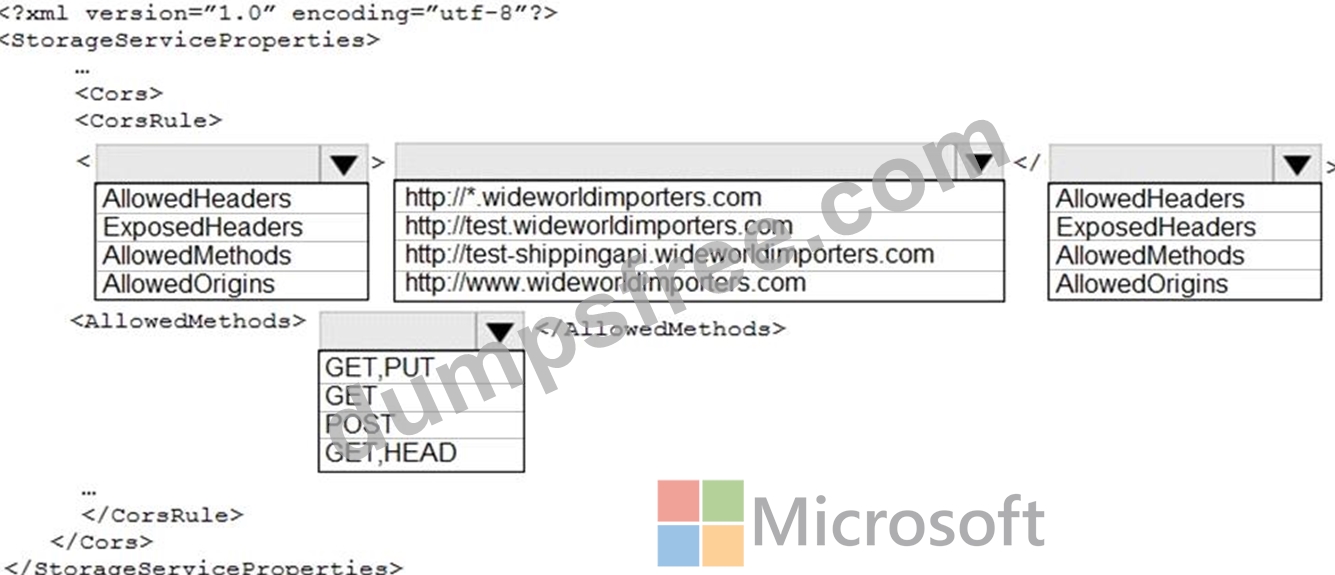
Answer:
Explanation: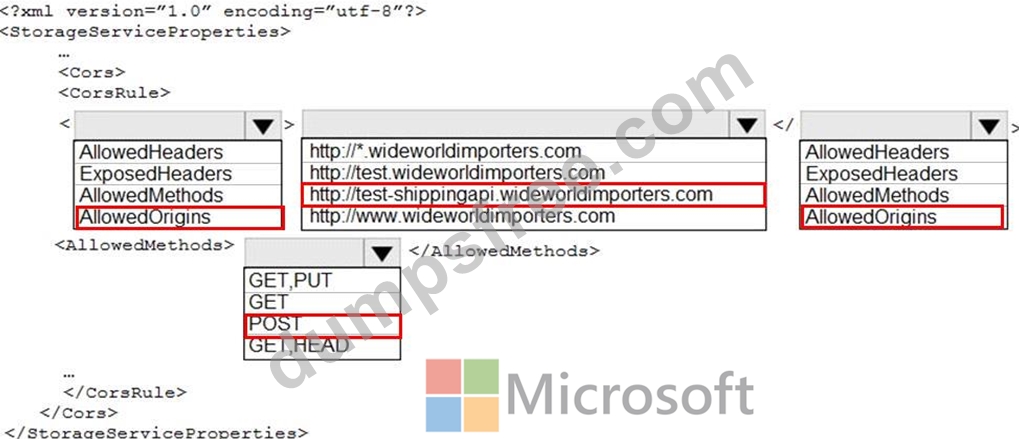
Reference:
https://developer.mozilla.org/en-US/docs/Web/HTTP/Headers/Access-Control-Allow-Origin
Topic 3, City Power & Light
Current environment
Architecture Overview
The company has a public website located at http://www.cpandl.com/. The site is a single-page web application that runs in Azure App Service on Linux. The website uses files stored in Azure Storage and cached in Azure Content Delivery Network (CDN) to serve static content.
API Management and Azure Function App functions are used to process and store data in Azure Database for PostgreSQL. API Management is used to broker communications to the Azure Function app functions for Logic app integration. Logic apps are used to orchestrate the data processing while Service Bus and Event Grid handle messaging and events.
The solution uses Application Insights, Azure Monitor, and Azure Key Vault.
Architecture diagram
The company has several applications and services that support their business. The company plans to implement serverless computing where possible. The overall architecture is shown below.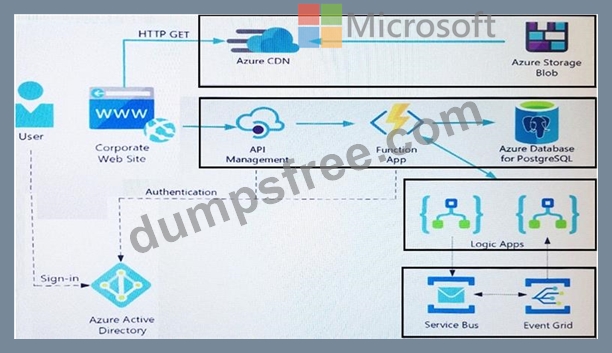
User authentication
The following steps detail the user authentication process:
The user selects Sign in in the website.
The browser redirects the user to the Azure Active Directory (Azure AD) sign in page.
The user signs in.
Azure AD redirects the user's session back to the web application. The URL includes an access token.
The web application calls an API and includes the access token in the authentication header. The application ID is sent as the audience ('aud') claim in the access token.
The back-end API validates the access token.
Requirements
Corporate website
Communications and content must be secured by using SSL.
Communications must use HTTPS.
Data must be replicated to a secondary region and three availability zones.
Data storage costs must be minimized.
Azure Database for PostgreSQL
The database connection string is stored in Azure Key Vault with the following attributes:
Azure Key Vault name: cpandlkeyvault
Secret name: PostgreSQLConn
Id: 80df3e46ffcd4f1cb187f79905e9a1e8
The connection information is updated frequently. The application must always use the latest information to connect to the database.
Azure Service Bus and Azure Event Grid
Azure Event Grid must use Azure Service Bus for queue-based load leveling.
Events in Azure Event Grid must be routed directly to Service Bus queues for use in buffering.
Events from Azure Service Bus and other Azure services must continue to be routed to Azure Event Grid for processing.
Security
All SSL certificates and credentials must be stored in Azure Key Vault.
File access must restrict access by IP, protocol, and Azure AD rights.
All user accounts and processes must receive only those privileges which are essential to perform their intended function.
Compliance
Auditing of the file updates and transfers must be enabled to comply with General Data Protection Regulation (GDPR). The file updates must be read-only, stored in the order in which they occurred, include only create, update, delete, and copy operations, and be retained for compliance reasons.
Issues
Corporate website
While testing the site, the following error message displays:
CryptographicException: The system cannot find the file specified.
Function app
You perform local testing for the RequestUserApproval function. The following error message displays:
'Timeout value of 00:10:00 exceeded by function: RequestUserApproval'
The same error message displays when you test the function in an Azure development environment when you run the following Kusto query:
FunctionAppLogs
| where FunctionName = = "RequestUserApproval"
Logic app
You test the Logic app in a development environment. The following error message displays:
'400 Bad Request'
Troubleshooting of the error shows an HttpTrigger action to call the RequestUserApproval function.
Code
Corporate website
Security.cs:
Function app
RequestUserApproval.cs: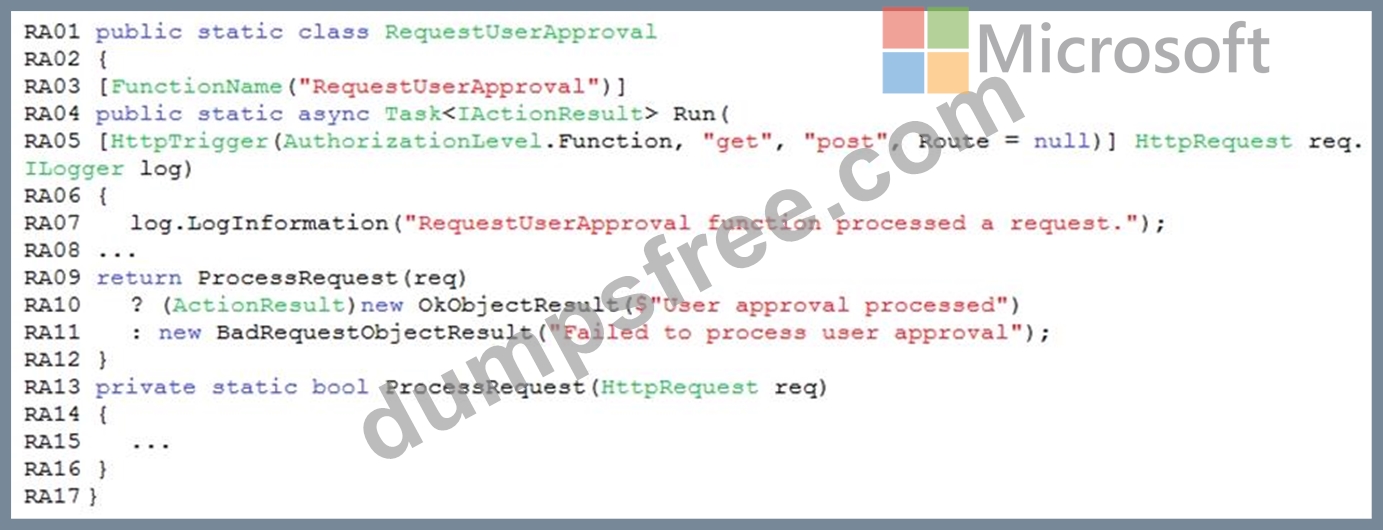
NEW QUESTION # 231
You have an application that provides weather forecasting data to external partners. You use Azure API Management to publish APIs.
You must change the behavior of the API to meet the following requirements:
* Support alternative input parameters.
* Remove formatting text from responses.
* Provide additional context to back-end services.
Which types of policies should you implement? To answer, drag the policy types to the correct scenarios. Each policy type may be used once, more than once, or not at all. You may need to drag the split bar between panes or scroll to view content NOTE: Each correct selection is worth one point.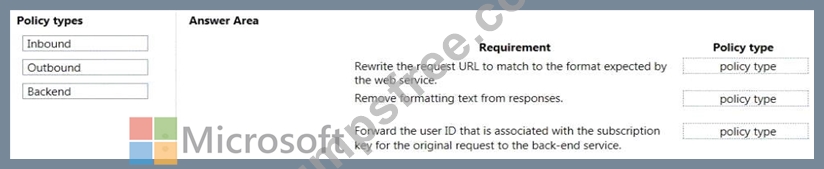
Answer:
Explanation: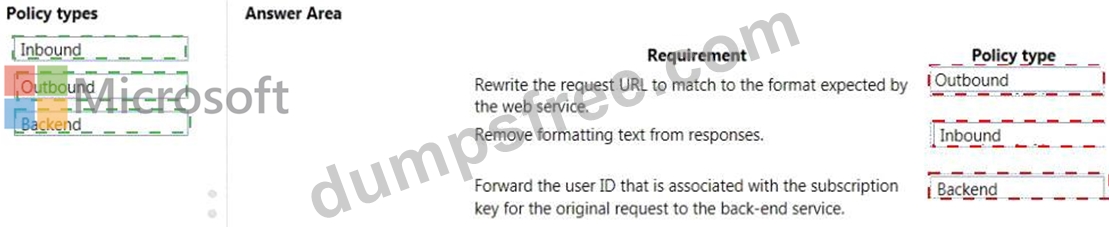
Explanation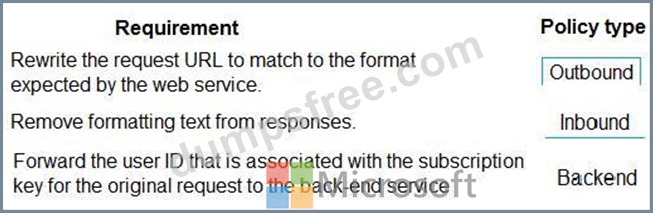
NEW QUESTION # 232
You ate designing a small app that will receive web requests containing encoded geographic coordinates.
Calls to the app will occur infrequently.
Which compute solution should you recommend?
- A. Azure API Management
- B. Azure App Service
- C. Azure Functions
- D. Azure Batch
Answer: B
NEW QUESTION # 233
Drag and Drop Question
Contoso, Ltd. provides an API to customers by using Azure API Management (APIM). The API authorizes users with a JWT token.
You must implement response caching for the APIM gateway. The caching mechanism must detect the user ID of the client that accesses data for a given location and cache the response for that user ID.
You need to add the following policies to the policies file:
* a set-variable policy to store the detected user identity
* a cache-lookup-value policy
* a cache-store-value policy
* a find-and-replace policy to update the response body with the user profile information To which policy section should you add the policies? To answer, drag the appropriate sections to the correct policies. Each section may be used once, more than once, or not at all. You may need to drag the split bar between panes or scroll to view content.
NOTE: Each correct selection is worth one point.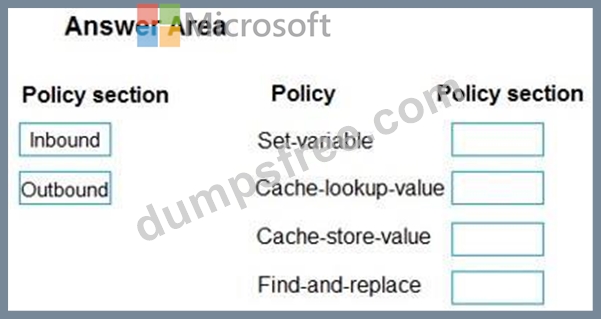
Answer:
Explanation: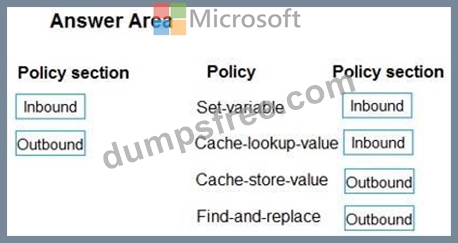
Explanation:
Box 1: Inbound.
A set-variable policy to store the detected user identity.
Example:
<policies>
<inbound>
<!--How you determine user identity is application dependent --> <set-variable name="enduserid" value="@(context.Request.Headers.GetValueOrDefault("Authorization","").Split('
')[1].AsJwt()? .Subject)" />
Etc.
Box 2: Inbound
A cache-lookup-value policy
Example:
<inbound>
<base />
<cache-lookup vary-by-developer="true | false" vary-by-developer-groups="true | false" downstream-caching-type="none | private | public" must-revalidate="true | false"> <vary-by-query- parameter>parameter name</vary-by-query-parameter> <!--optional, can repeated several times
-->
</cache-lookup>
</inbound>
Box 3: Outbound
A cache-store-value policy.
Example:
<outbound>
<base />
<cache-store duration="3600" />
</outbound>
Box 4: Outbound
A find-and-replace policy to update the response body with the user profile information.
Example:
<outbound>
<!--Update response body with user profile-->
<find-and-replace
from='"$userprofile$"'
to="@((string)context.Variables["userprofile"])" />
<base />
</outbound>
References:
https://docs.microsoft.com/en-us/azure/api-management/api-management-caching-policies
https://docs.microsoft.com/en-us/azure/api-management/api-management-sample-cache-by-key
NEW QUESTION # 234
You have an Azure Queue Storage named queuel You plan to develop code that will process messages in queuel.
You need to implement a queue operation to set the visibility timeout value of individual messages in queuel.
Which two operations can you use? Each correct answer presents a complete solution.
NOTE: Each correct selection is worth one point.
- A. Update a message in the queue.
- B. Peek at a message in the queue.
- C. Add a message to the queuer t
- D. Delete a message in the queue.
- E. Receive a message from the queue.
Answer: A,C
NEW QUESTION # 235
A web service provides customer summary information for e-commerce partners. The web service is implemented as an Azure Function app with an HTTP trigger. Access to the API is provided by an Azure API Management instance. The API Management instance is configured in consumption plan mode. All API calls are authenticated by using OAuth.
API calls must be cached. Customers must not be able to view cached data for other customers.
You need to configure API Management policies for caching.
How should you complete the policy statement?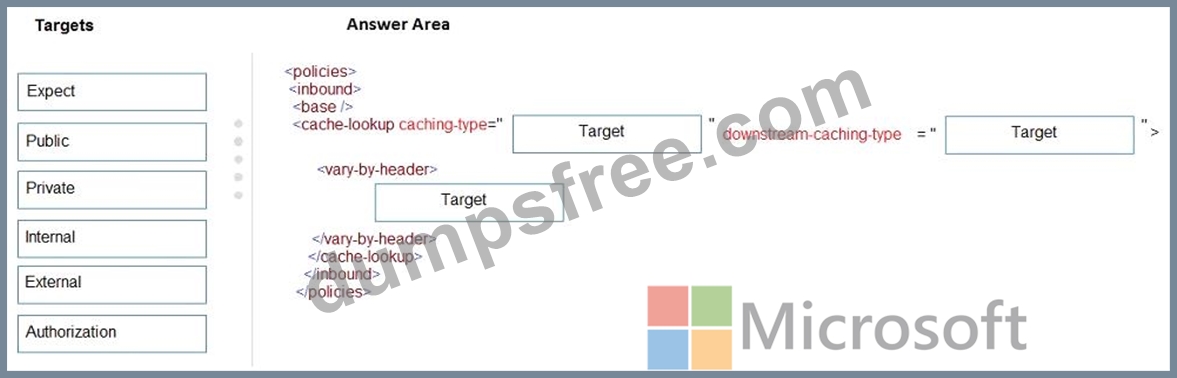
Answer:
Explanation: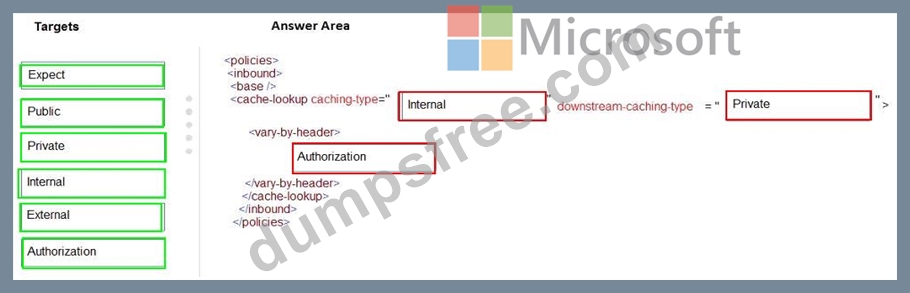
Reference:
https://docs.microsoft.com/en-us/azure/api-management/api-management-caching-policies
NEW QUESTION # 236
You develop a website. You plan to host the website in Azure. You expect the website to experience high traffic volumes after it is published. You must ensure that the website remains available and responsive while minimizing cost. You need to deploy the website. What should you do?
- A. Deploy the website to an App Service that uses the Standard service tier. Configure the App Service plan to automatically scale when the CPU load is high.
- B. Deploy the website to a virtual machine. Configure a Scale Set to increase the virtual machine instance count when the CPU load
- C. Deploy the website to an App Service that uses the Shared service tier. Configure the App Service plan to automatically scale when the CPU load is high.
- D. Deploy the website to a virtual machine. Configure the virtual machine to automatically scale when the CPU load is high.
Answer: A
NEW QUESTION # 237
You are developing an Azure App Service hosted ASP.NET Core web app to deliver video on-demand streaming medi a. You enable an Azure Content Delivery Network (CDN) Standard for the web endpoint. Customer videos are downloaded from the web app by using the following example URL.: http://www.contoso.com/content.mp4?quality=1 All media content must expire from the cache after one hour. Customer videos with varying quality must be delivered to the closest regional point of presence (POP) node.
You need to configure Azure CDN caching rules.
Which options should you use? To answer, select the appropriate options in the answer area.
NOTE: Each correct selection is worth one point.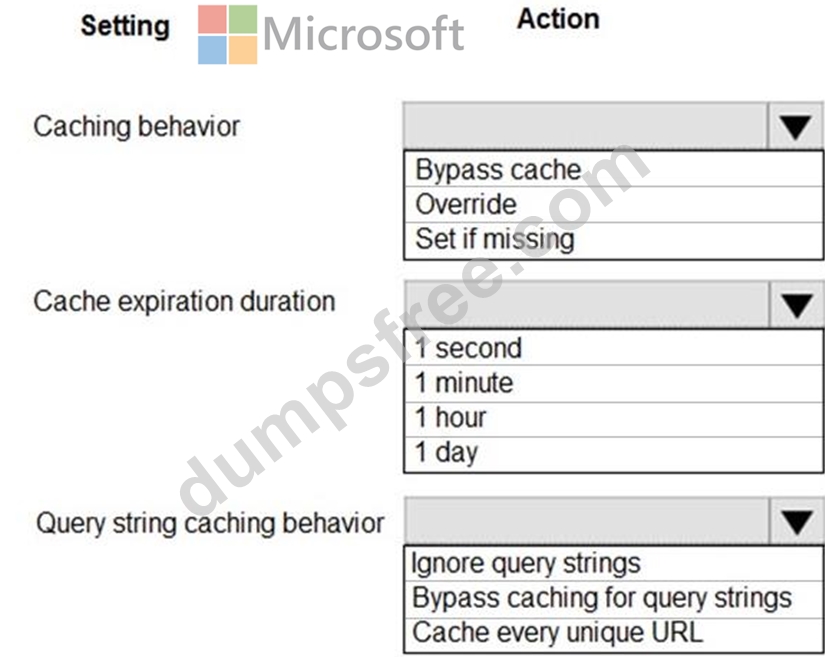
Answer:
Explanation: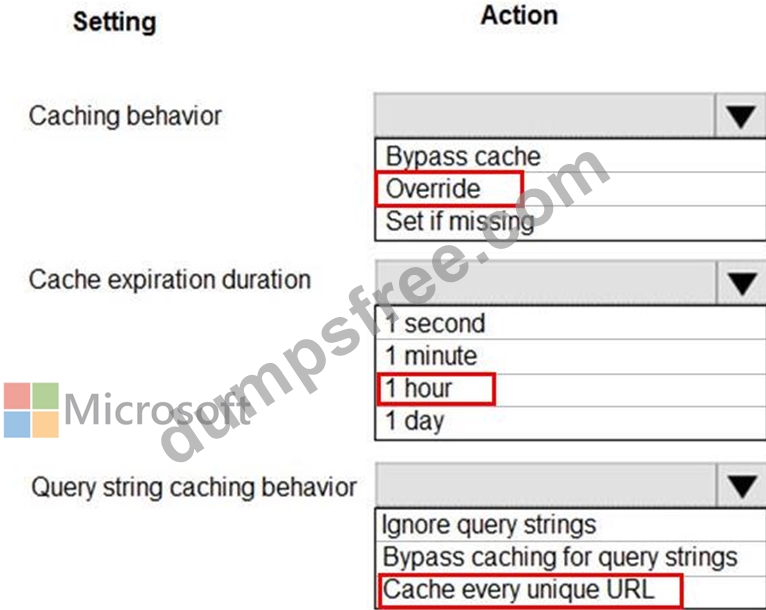
Reference:
https://docs.microsoft.com/en-us/azure/cdn/cdn-query-string
NEW QUESTION # 238
You need to implement the Log policy.
How should you complete the Azure Event Grid subscription? To answer, drag the appropriate JSON segments to the correct locations. Each JSON segment may be used once, more than once, or not at all. You may need to drag the split bar between panes to view content.
NOTE: Each correct selection is worth one point.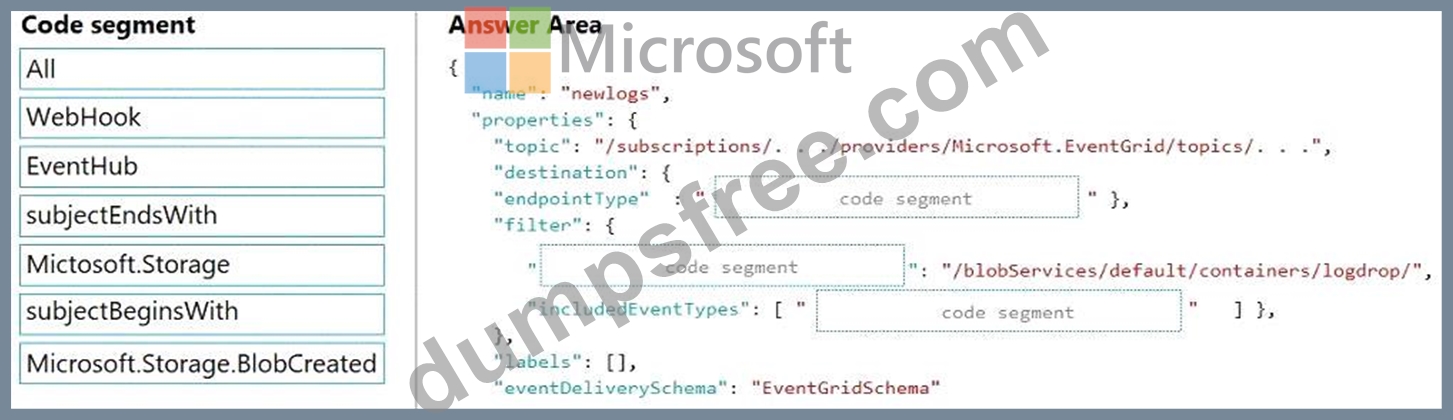
Answer:
Explanation: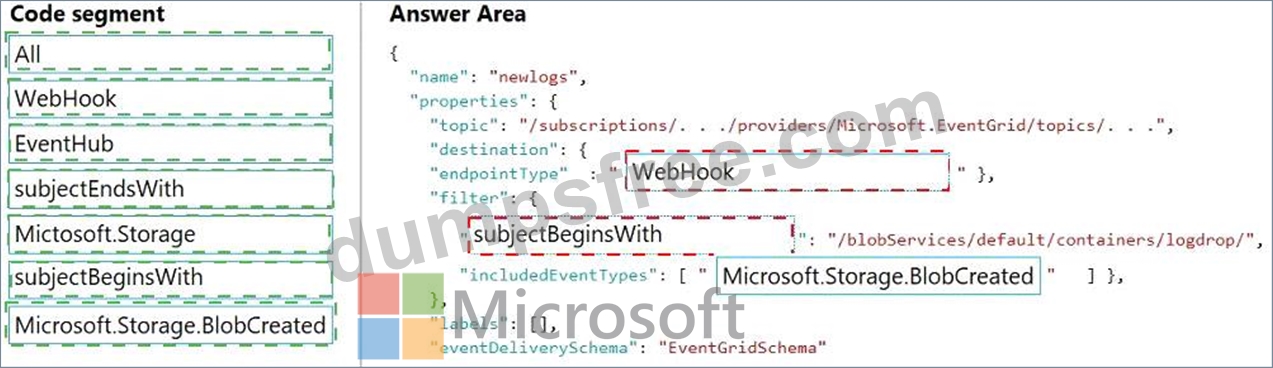
Explanation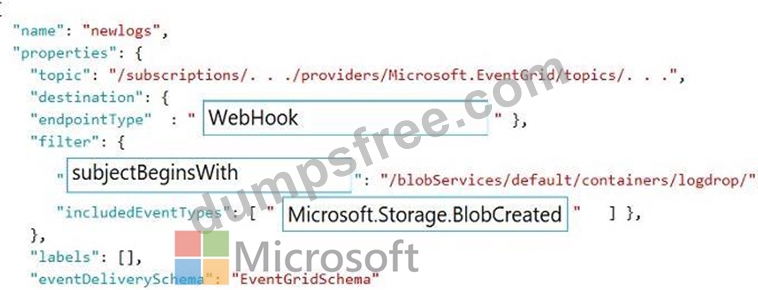
Box 1:WebHook
Scenario: If an anomaly is detected, an Azure Function that emails administrators is called by using an HTTP WebHook.
endpointType: The type of endpoint for the subscription (webhook/HTTP, Event Hub, or queue).
Box 2: SubjectBeginsWith
Box 3: Microsoft.Storage.BlobCreated
Scenario: Log Policy
All Azure App Service Web Apps must write logs to Azure Blob storage. All log files should be saved to a container named logdrop. Logs must remain in the container for 15 days.
Example subscription schema
{
"properties": {
"destination": {
"endpointType": "webhook",
"properties": {
"endpointUrl":
"https://example.azurewebsites.net/api/HttpTriggerCSharp1?code=VXbGWce53l48Mt8wuotr0GPmyJ/nDT4hgd
}
},
"filter": {
"includedEventTypes": [ "Microsoft.Storage.BlobCreated", "Microsoft.Storage.BlobDeleted" ],
"subjectBeginsWith": "blobServices/default/containers/mycontainer/log",
"subjectEndsWith": ".jpg",
"isSubjectCaseSensitive ": "true"
}
}
}
Reference:
https://docs.microsoft.com/en-us/azure/event-grid/subscription-creation-schema
Topic 5, Litware Inc
Case study
This is a case study. Case studies are not timed separately. You can use as much exam time as you would like to complete each case. However, there may be additional case studies and sections on this exam. You must manage your time to ensure that you are able to complete all questions included on this exam in the time provided.
To answer the questions included in a case study, you will need to reference information that is provided in the case study. Case studies might contain exhibits and other resources that provide more information about the scenario that is described in the case study. Each question is independent of the other questions in this case study.
At the end of this case study, a review screen will appear. This screen allows you to review your answers and to make changes before you move to the next section of the exam. After you begin a new section, you cannot return to this section.
To start the case study
To display the first question in this case study, click the button. Use the buttons in the left pane to explore the content of the case study before you answer the questions. Clicking these buttons displays information such as business requirements, existing environment, and problem statements. When you are ready to answer a question, click the Background You are a developer for Litware Inc., a SaaS company that provides a solution for managing employee expenses. The solution consists of an ASP.NET Core Web API project that is deployed as an Azure Web App.
Overall architecture
Employees upload receipts for the system to process. When processing is complete, the employee receives a summary report email that details the processing results. Employees then use a web application to manage their receipts and perform any additional tasks needed for reimbursement.
Receipt processing
Employees may upload receipts in two ways:
* Uploading using an Azure Files mounted folder
* Uploading using the web application
Data Storage
Receipt and employee information is stored in an Azure SQL database.
Documentation
Employees are provided with a getting started document when they first use the solution. The documentation includes details on supported operating systems for Azure File upload, and instructions on how to configure the mounted folder.
Solution details
Users table
Web Application
You enable MSI for the Web App and configure the Web App to use the security principal name WebAppIdentity.
Processing
Processing is performed by an Azure Function that uses version 2 of the Azure Function runtime. Once processing is completed, results are stored in Azure Blob Storage and an Azure SQL database. Then, an email summary is sent to the user with a link to the processing report. The link to the report must remain valid if the email is forwarded to another user.
Logging
Azure Application Insights is used for telemetry and logging in both the processor and the web application.
The processor also has TraceWriter logging enabled. Application Insights must always contain all log messages.
Requirements
Receipt processing
Concurrent processing of a receipt must be prevented.
Disaster recovery
Regional outage must not impact application availability. All DR operations must not be dependent on application running and must ensure that data in the DR region is up to date.
Security
* User's SecurityPin must be stored in such a way that access to the database does not allow the viewing of SecurityPins. The web application is the only system that should have access to SecurityPins.
* All certificates and secrets used to secure data must be stored in Azure Key Vault.
* You must adhere to the principle of least privilege and provide privileges which are essential to perform the intended function.
* All access to Azure Storage and Azure SQL database must use the application's Managed Service Identity (MSI).
* Receipt data must always be encrypted at rest.
* All data must be protected in transit.
* User's expense account number must be visible only to logged in users. All other views of the expense account number should include only the last segment, with the remaining parts obscured.
* In the case of a security breach, access to all summary reports must be revoked without impacting other parts of the system.
Issues
Upload format issue
Employees occasionally report an issue with uploading a receipt using the web application. They report that when they upload a receipt using the Azure File Share, the receipt does not appear in their profile. When this occurs, they delete the file in the file share and use the web application, which returns a 500 Internal Server error page.
Capacity issue
During busy periods, employees report long delays between the time they upload the receipt and when it appears in the web application.
Log capacity issue
Developers report that the number of log messages in the trace output for the processor is too high, resulting in lost log messages.
Application code
Processing.cs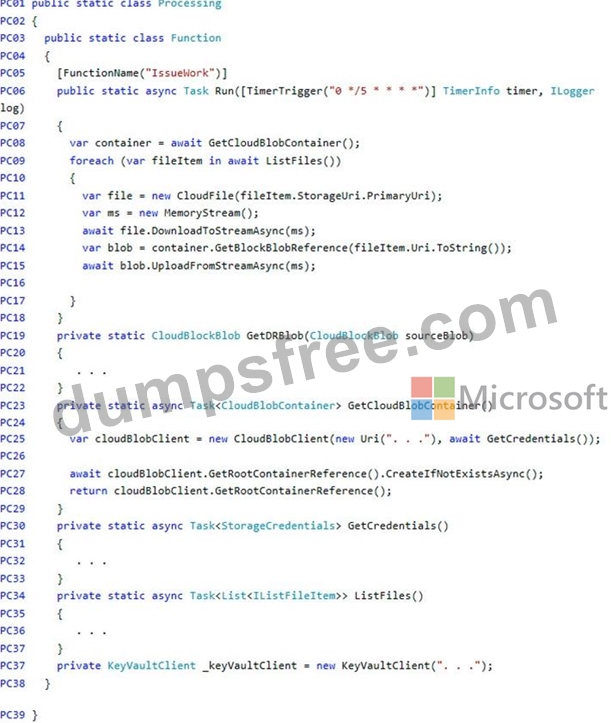
Database.cs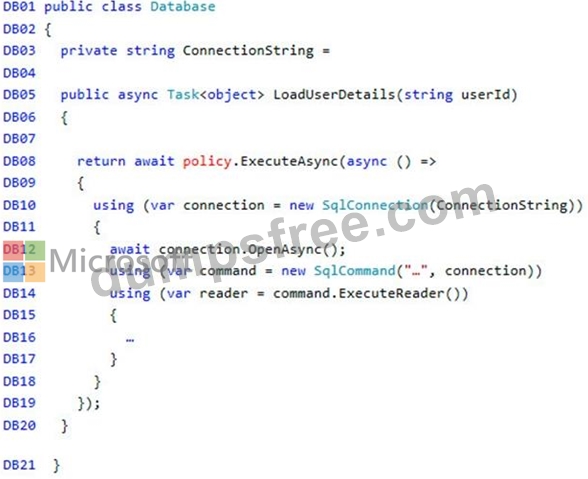
ReceiptUploader.cs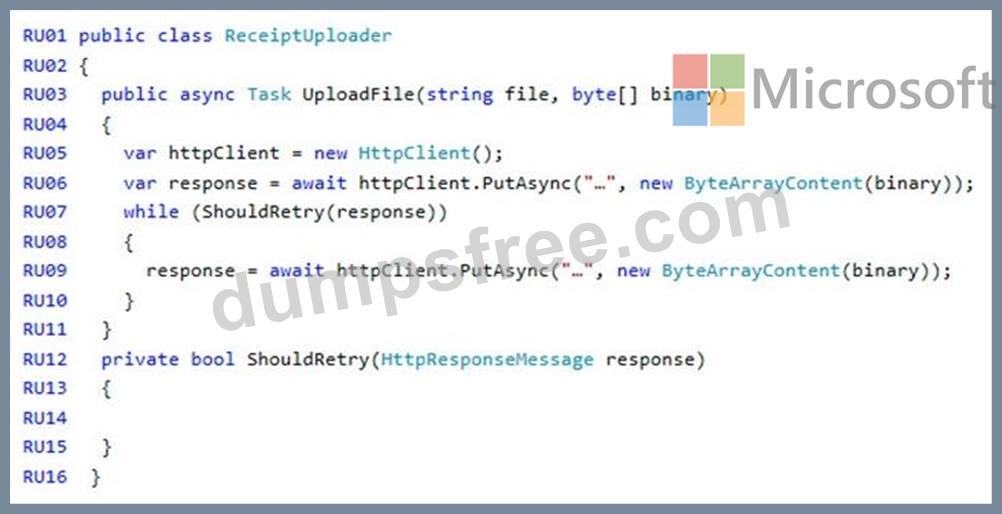
ConfigureSSE.ps1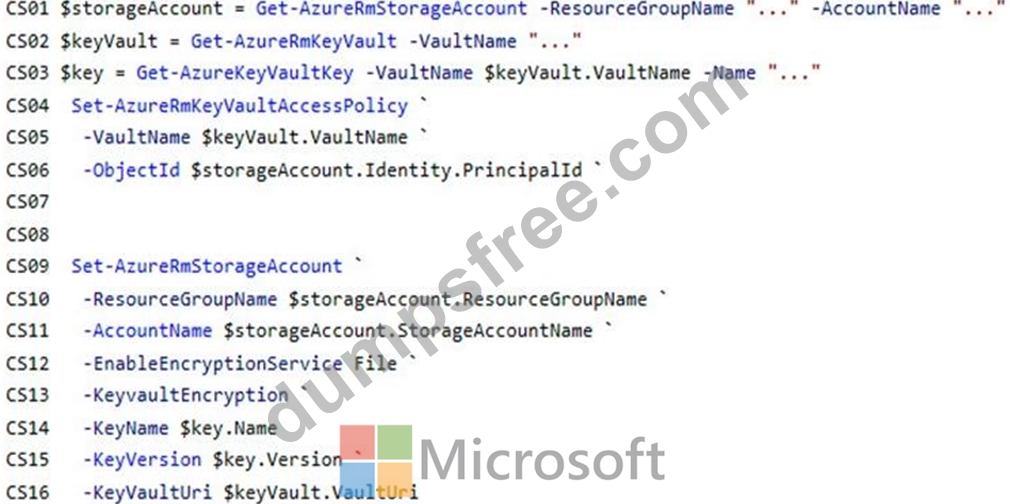
NEW QUESTION # 239
You are deploying an Azure Kubernetes Services (AKS) cluster that will use multiple containers.
You need to create the cluster and verify that the services for the containers are configured correctly and available.
Which four commands should you use to develop the solution? To answer, move the appropriate command segments from the list of command segments to the answer area and arrange them in the correct order.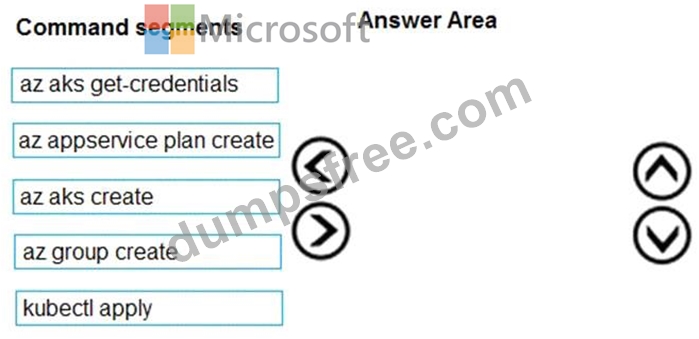
Answer:
Explanation: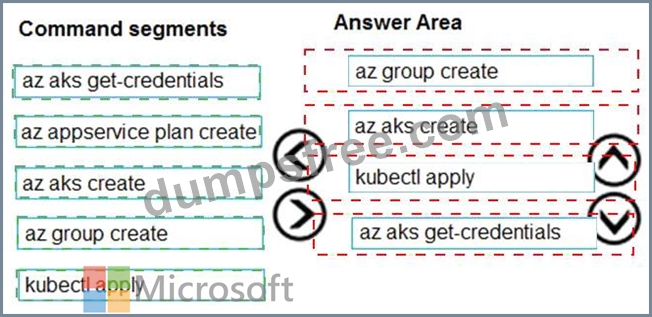
Explanation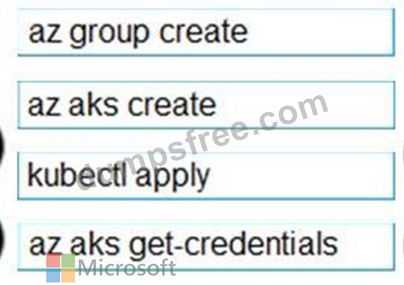
Step 1: az group create
Create a resource group with the az group create command. An Azure resource group is a logical group in which Azure resources are deployed and managed.
Example: The following example creates a resource group named myAKSCluster in the eastus location.
az group create --name myAKSCluster --location eastus
Step 2 : az aks create
Use the az aks create command to create an AKS cluster.
Step 3: kubectl apply
To deploy your application, use the kubectl apply command. This command parses the manifest file and creates the defined Kubernetes objects.
Step 4: az aks get-credentials
Configure it with the credentials for the new AKS cluster. Example:
az aks get-credentials --name aks-cluster --resource-group aks-resource-group References:
https://docs.bitnami.com/azure/get-started-aks/
NEW QUESTION # 240
You need to update the APIs to resolve the testing error.
How should you complete the Azure CLI command? To answer, select the appropriate options in the answer area.
NOTE: Each correct selection is worth one point.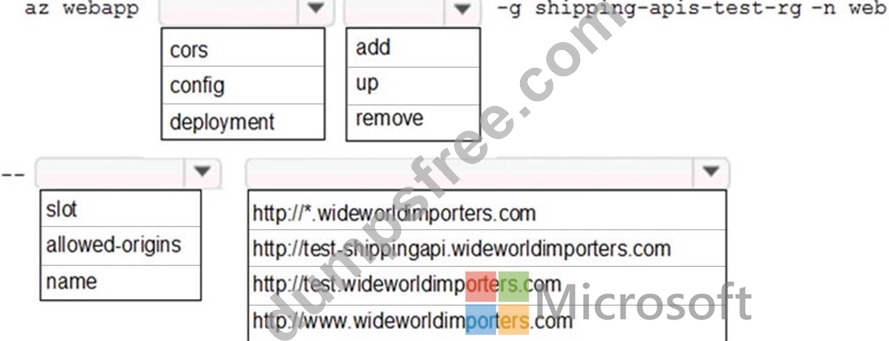
Answer:
Explanation: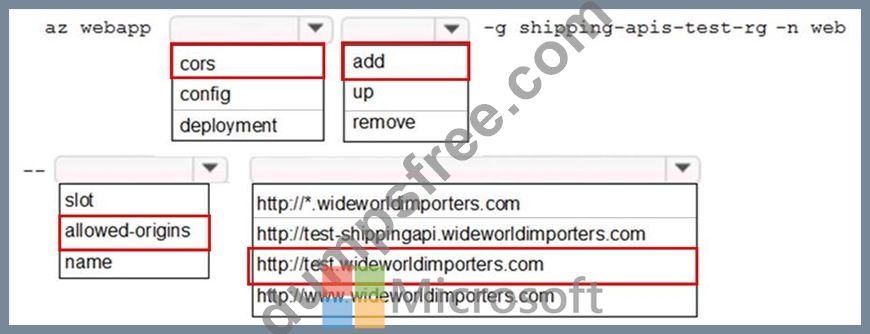
Reference:
http://donovanbrown.com/post/How-to-clear-No-Access-Control-Allow-Origin-header-error-with-Azure-App-Service
NEW QUESTION # 241
Note: This question is part of a series of questions that present the same scenario. Each question in the series contains a unique solution that might meet the stated goals. Some question sets might have more than one correct solution, while others might not have a correct solution.
After you answer a question in this section, you will NOT be able to return to it. As a result, these questions will not appear in the review screen.
You develop and deploy an Azure App Service API app to a Windows-hosted deployment slot named Development. You create additional deployment slots named Testing and Production. You enable auto swap on the Production deployment slot.
You need to ensure that scripts run and resources are available before a swap operation occurs.
Solution: Disable auto swap. Update the app with a method named statuscheck to run the scripts. Re-enable auto swap and deploy the app to the Production slot.
Does the solution meet the goal?
- A. Yes
- B. No
Answer: A
Explanation:
Instead update the web.config file to include the applicationInitialization configuration element. Specify custom initialization actions to run the scripts.
Note: Some apps might require custom warm-up actions before the swap. The applicationInitialization configuration element in web.config lets you specify custom initialization actions. The swap operation waits for this custom warm-up to finish before swapping with the target slot. Here's a sample web.config fragment.
<system.webServer>
<applicationInitialization>
<add initializationPage="/" hostName="[app hostname]" />
<add initializationPage="/Home/About" hostName="[app hostname]" />
</applicationInitialization>
</system.webServer>
Reference:
https://docs.microsoft.com/en-us/azure/app-service/deploy-staging-slots#troubleshoot-swaps
NEW QUESTION # 242
You develop software solutions for a mobile delivery service. You are developing a mobile app that users can use to order from a restaurant in their area. The app uses the following workflow:
1. A driver selects the restaurants for which they will deliver orders.
2. Orders are sent to all available drivers in an area.
3. Only orders for the selected restaurants will appear for the driver.
4. The first driver to accept an order removes it from the list of available orders.
You need to implement an Azure Service Bus solution.
Which three actions should you perform in sequence? To answer, move the appropriate actions from the list of actions to the answer area and arrange them in the correct order.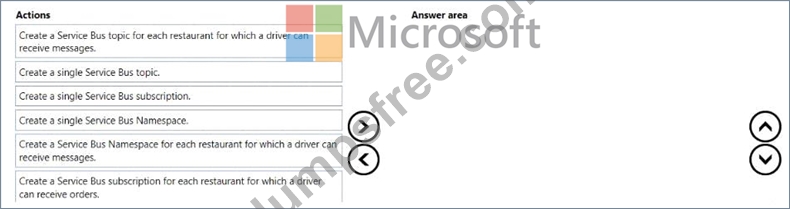
Answer:
Explanation: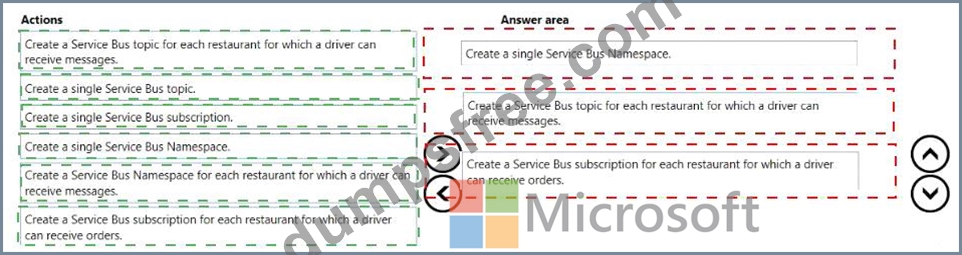
Explanation: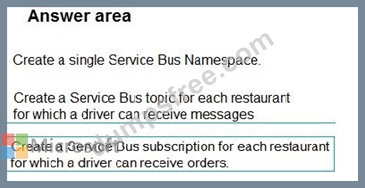
Box 1: Create a single Service Bus Namespace
To begin using Service Bus messaging entities in Azure, you must first create a namespace with a name that is unique across Azure. A namespace provides a scoping container for addressing Service Bus resources within your application.
Box 2: Create a Service Bus Topic for each restaurant for which a driver can receive messages.
Create topics.
Box 3: Create a Service Bus subscription for each restaurant for which a driver can receive orders.
Topics can have multiple, independent subscriptions.
References:
https://docs.microsoft.com/en-us/azure/service-bus-messaging/service-bus-messaging-overview
NEW QUESTION # 243
You develop an Azure solution that uses Cosmos DB.
The current Cosmos DB container must be replicated and must use a partition key that is optimized for queries.
You need to implement a change feed processor solution.
Which change feed processor components should you use? To answer, drag the appropriate components to the correct requirements. Each component may be used once, more than once, or not at all. You may need to drag the split bar between panes or scroll to view the content.
NOTE: Each correct selection is worth one point.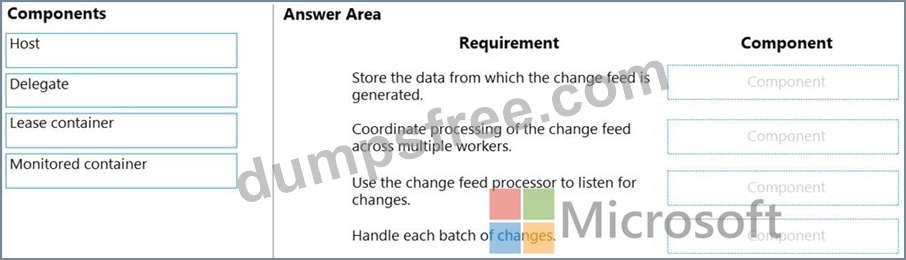
Answer:
Explanation: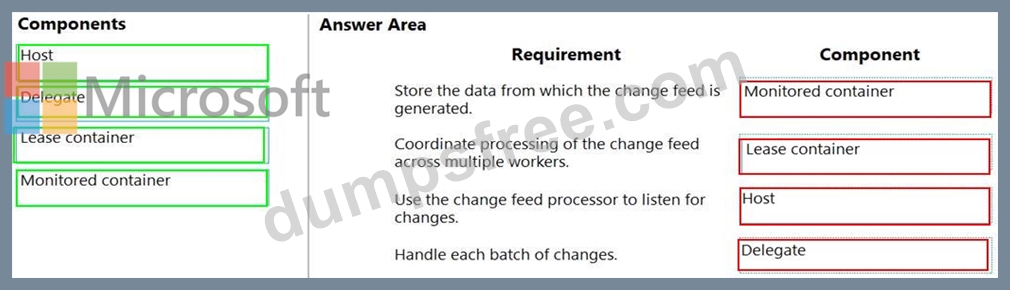
Reference:
https://docs.microsoft.com/en-us/azure/cosmos-db/change-feed-processor
NEW QUESTION # 244
You need to resolve the authentication errors for developers.
Which Service Bus security configuration should you use? To answer, select the appropriate options in the answer area.
NOTE: Each correct selection is worth one point.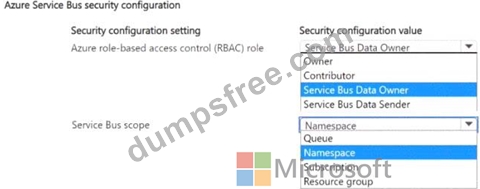
Answer:
Explanation: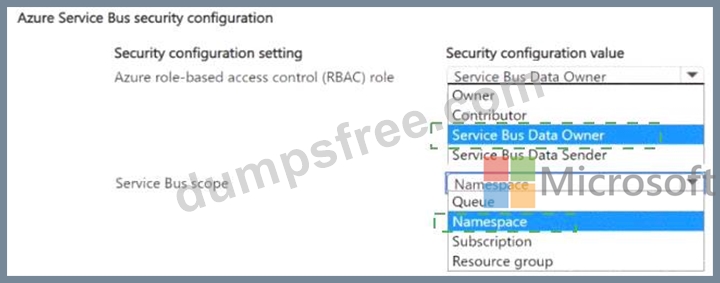
Explanation:
Topic 9, Fourth Coffee
Background
Current Environment
Fourth Coffee is a global coffeehouse chain and coffee company recognized as one of the world's most influential coffee brands. The company is renowned for its specialty coffee beverages, including a wide range of espresso-based dnnks, teas, and other beverages. Fourth Coffee operates thousands of stores worldwide.
The company is developing cloud-native applications hosted in Azure.
Corporate website
The
company hosts a public website located at http://www.fourthcoffee.com/. The website is used to place orders as well as view and update inventory items.
Inventory items
In addition to its core coffee offerings, Fourth Coffee recently expanded its menu to include inventory items such as lunch items, snacks, and merchandise. Corporate team members constantly update inventory. Users can customize items. Corporate team members configure inventory items and associated images on the website.
Orders
Associates in the store serve customized beverages and items to customers. Orders are placed on the website for pickup.
The application components process data as follows:
1. Azure Traffic Manager routes a user order request to the corporate website hosted in Azure App Service.
2. Azure Content Delivery Network serves static images and content to the user.
3. The user signs in to the application through a Microsoft Entra ID for customers tenant.
4. Users search for items and place an order on the website as item images are pulled from Azure Blob Storage
5. Item customizations are placed in an Azure Service Bus queue message.
6. Azure Functions processes item customizations and saves the customized items to Azure Cosmos DB.
7. The website saves order details to Azure SQL Database.
8. SQL Database query results are cached in Azure Cache for Redis to improve performance.
The application consists of the following Azure services: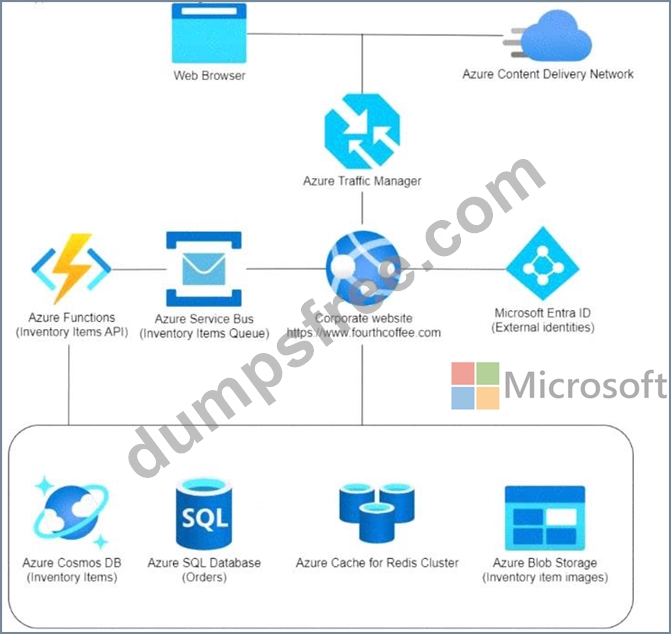
Requirements
The application components must meet the following requirements:
* Azure Cosmos DB development must use a native API that receives the latest updates and stores data in a document format.
* Costs must be minimized for all Azure services.
* Developers must test Azure Blob Storage integrations locally before deployment to Azure Testing must support the latest versions of the Azure Storage APIs.
Corporate website
* User authentication and authorization must allow one-time passcode sign-in methods and social identity providers (Google or Facebook).
* Static web content must be stored closest to end users to reduce network latency.
Inventory items
* Customized items read from Azure Cosmos DB must maximize throughput while ensuring data is accurate for the current user on the website.
* Processing of inventory item updates must automatically scale and enable updates across an entire Azure Cosmos DB container.
* Inventory items must be processed in the order they were placed in the queue.
* Inventory item images must be stored as JPEG files in their native format to include exchangeable image file format (data) stored with the blob data upon upload of the image file.
* The Inventory Items API must securely access the Azure Cosmos DB data.
Orders
* Orders must receive inventory item changes automatically after inventory items are updated or saved.
Issues
* Developers are storing the Azure Cosmos DB credentials in an insecure clear text manner within the Inventory Items API code.
* Production Azure Cache for Redis maintenance has negatively affected application performance.
NEW QUESTION # 245
You are preparing to deploy an Azure virtual machine (VM) based application. The VMs that run the application have the following requirements:
* When a VM is provisioned the firewall must be automatically configured before it can access Azure resources.
* Supporting services must be installed by using an Azure PowerShell script that is stored in Azure Storage You need to ensure that the requirements are met.
Which features should you use? To answer, drag the appropriate features to the correct requirements.
Answer:
Explanation:
Reference:
https://docs.microsoft.com/en-us/azure/automation/automation-hybrid-runbook-worker
https://docs.microsoft.com/en-us/azure/virtual-machines/windows/run-command
NEW QUESTION # 246
Your company is developing an Azure API.
You need to implement authentication for the Azure API. You have the following requirements:
- All API calls must be secure.
- Callers to the API must not send credentials to the API.
Which authentication mechanism should you use?
- A. Anonymous
- B. Client certificate
- C. Basic
- D. Managed identity
Answer: D
Explanation:
Use the authentication-managed-identity policy to authenticate with a backend service using the managed identity of the API Management service. This policy essentially uses the managed identity to obtain an access token from Azure Active Directory for accessing the specified resource. After successfully obtaining the token, the policy will set the value of the token in the Authorization header using the Bearer scheme.
Reference:
https://docs.microsoft.com/bs-cyrl-ba/azure/api-management/api-management-authentication- policies
NEW QUESTION # 247
A company runs an international travel and bookings management service. The company plans to begin offering restaurant bookings. You must develop a solution that uses Azure Search and meets the following requirements:
* Users must be able to search for restaurants by name, description, location, and cuisine.
* Users must be able to narrow the results further by location, cuisine, rating, and family-friendliness.
* All words in descriptions must be included in searches.
You need to add annotations to the restaurant class.
How should you complete the code segment? To answer, select the appropriate options in the answer area.
NOTE: Each correct selection is worth one point.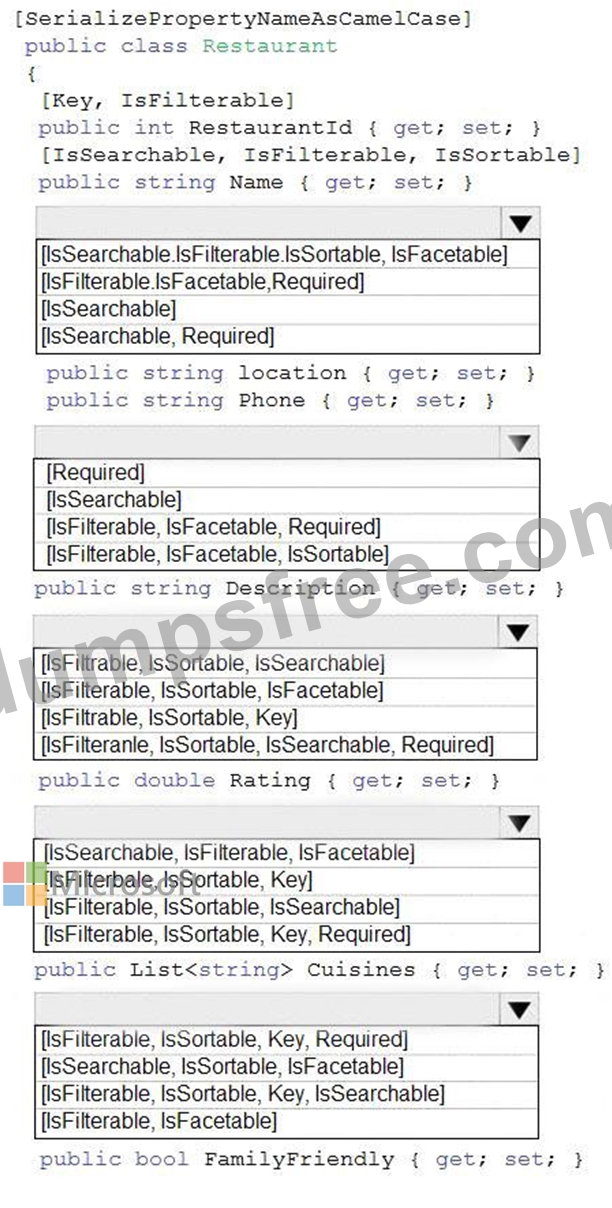
Answer:
Explanation: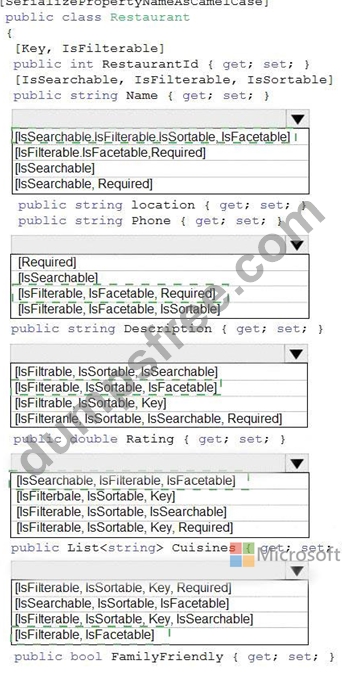
Explanation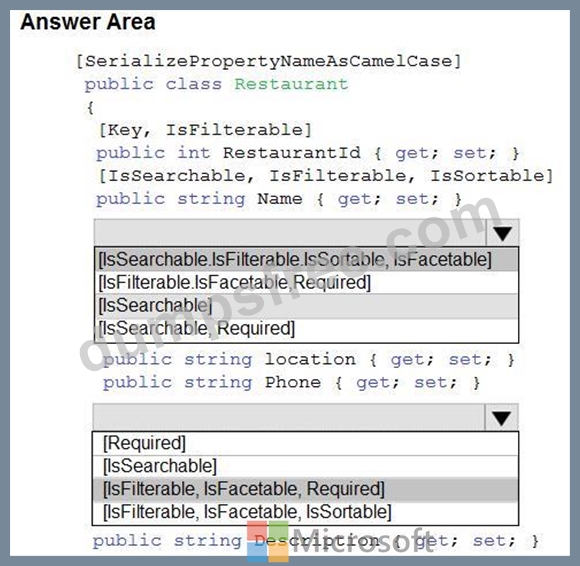
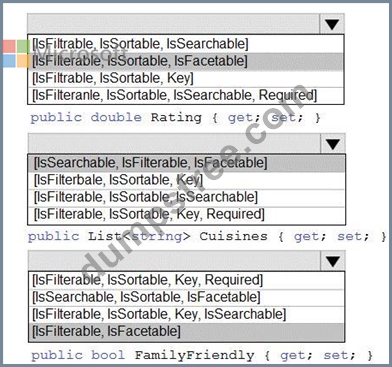
Box 1: [IsSearchable.IsFilterable.IsSortable,IsFacetable]
Location
Users must be able to search for restaurants by name, description, location, and cuisine.
Users must be able to narrow the results further by location, cuisine, rating, and family-friendliness.
Box 2: [IsSearchable.IsFilterable.IsSortable,Required]
Description
Users must be able to search for restaurants by name, description, location, and cuisine.
All words in descriptions must be included in searches.
Box 3: [IsFilterable,IsSortable,IsFaceTable]
Rating
Users must be able to narrow the results further by location, cuisine, rating, and family-friendliness.
Box 4: [IsSearchable.IsFilterable,IsFacetable]
Cuisines
Users must be able to search for restaurants by name, description, location, and cuisine.
Users must be able to narrow the results further by location, cuisine, rating, and family-friendliness.
Box 5: [IsFilterable,IsFacetable]
FamilyFriendly
Users must be able to narrow the results further by location, cuisine, rating, and family-friendliness.
References:
https://www.henkboelman.com/azure-search-the-basics/
NEW QUESTION # 248
Case Study 2
Requirements
ContentAnalysisService
The company's data science group built ContentAnalysisService which accepts user generated content as a string and returns a probable value for inappropriate content. Any values over a specific threshold must be reviewed by an employee of Contoso, Ltd.
You must create an Azure Function named CheckUserContent to perform the content checks.
Costs
You must minimize costs for all Azure services.
Manual review
To review content, the user must authenticate to the website portion of the ContentAnalysisService using their Azure AD credentials. The website is built using React and all pages and API endpoints require authentication. In order to review content a user must be part of a ContentReviewer role. All completed reviews must include the reviewer's email address for auditing purposes.
High availability
All services must run in multiple regions. The failure of any service in a region must not impact overall application availability.
Monitoring
An alert must be raised if the ContentUploadService uses more than 80 percent of available CPU-cores.
Security
You have the following security requirements:
* Any web service accessible over the Internet must be protected from cross site scripting attacks.
* All websites and services must use SSL from a valid root certificate authority.
* Azure Storage access keys must only be stored in memory and must be available only to the service.
* All Internal services must only be accessible from Internal Virtual Networks (VNets)
* All parts of the system must support inbound and outbound traffic restrictions.
* All service calls must be authenticated by using Azure AD.
User agreements
When a user submits content, they must agree to a user agreement. The agreement allows employees of Contoso.Ltd to review content, store cookies on user devices and track user's IP addresses.
Information regarding agreements is used by multiple divisions within Contoso, Ltd.
User responses must not be lost and must be available to all parties regardless of individual service uptime. The volume of agreements is expected to be in the millions per hour.
Validation testing
When a new version of the ContentAnalysisService is available the previous seven days of content must be processed with the new version to verify that the new version does not significantly deviate from the old version.
Issues
Users of the ContentUploadService report that they occasionally see HTTP 502 responses on specific pages.
Code
ContentUploadService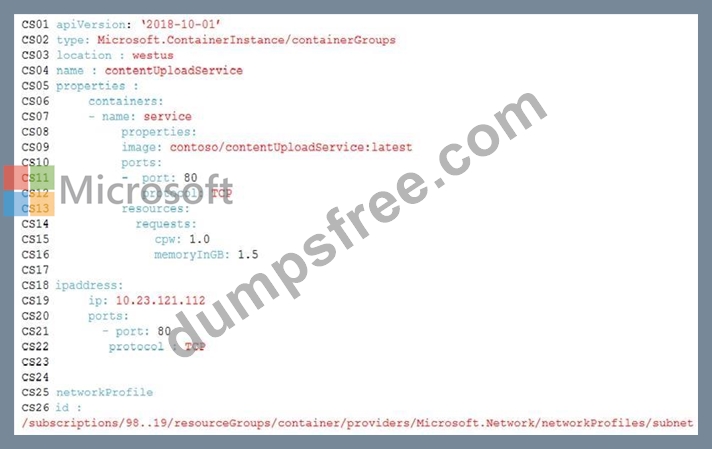
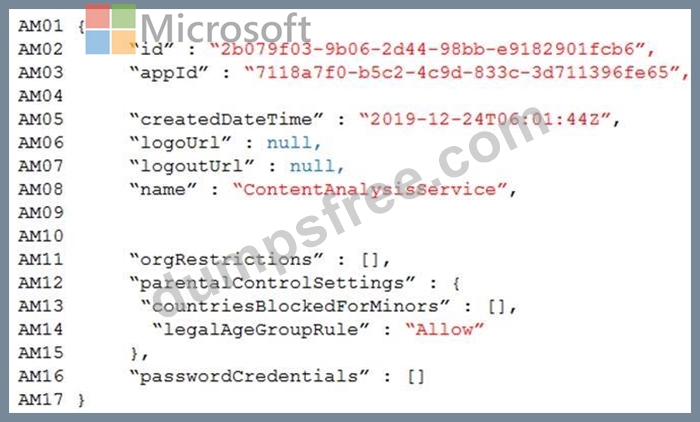
You need to configure the ContentUploadService deployment.
Which two actions should you perform? Each correct answer presents part of the solution.
NOTE: Each correct selection is worth one point.
- A. Add the following markup to line CS24:
osType: Linux - B. Add the following markup to line CS23:
types: Public - C. Add the following markup to line CS23:
types: Private - D. Add the following markup to line CS24:
osType: Windows
Answer: C
Explanation:
Scenario: All Internal services must only be accessible from Internal Virtual Networks (VNets) There are three Network Location types - Private, Public and Domain Reference:
https://devblogs.microsoft.com/powershell/setting-network-location-to-private/
NEW QUESTION # 249
......
Cover AZ-204 Exam Questions Make Sure You 100% Pass: https://prep4sure.dumpsfree.com/AZ-204-valid-exam.html